










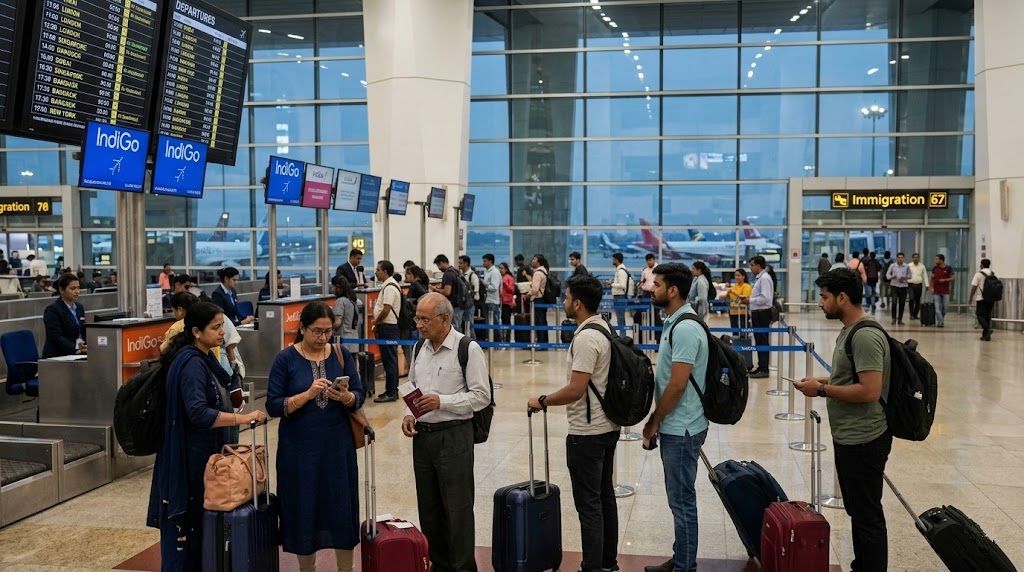
India’s international air travel reached a new milestone in Q4 FY26 (October–December 2025), with passenger numbers surpassing 20 million for the first time in a single quarter, according to the Directorate General of Civil Aviation (DGCA). Over the full calendar year 2025, total outbound and inbound international air traffic hit 78 million passengers, up about 8% from 72 million in 2024, underscoring the sector’s continued recovery and expansion.asianhospitality+1
Regional demand and capacity shifts
Demand for flights to and from India remained strong, especially in Asia, where growth offset a slowdown in North American traffic caused by visa‑related headwinds and tighter US‑Canada‑focused approvals. The transpacific and Europe‑India routes also saw steady growth, but the biggest gains came from intra‑Asian connectivity, including better‑networked low‑cost and full‑service links. Notably, foreign carriers still controlled about 54% of the international market share, as India has not yet materially expanded bilateral flying rights for many of the key foreign‑airline‑heavy markets.timesofindia.indiatimes+2
Carrier‑level dynamics
Within domestic‑owned operations, IndiGo overtook the Air India Group (Air India + Air India Express) as the largest operator of international passengers in and out of India, marking a shift in who drives India’s cross‑border traffic. The change occurred in the second half of 2025, with IndiGo deploying more international capacity and optimizing short‑ and medium‑haul routes, particularly to Southeast and West Asia, while the Air India Group trimmed frequencies after operational and safety‑review adjustments following the AI 171 Ahmedabad crash in June 2025. For the Indian carrier group, this shift has meant a sharper focus on long‑haul, full‑service, and code‑share‑driven markets, while the domestic‑cost‑carrier segment picked up a larger share of thinner point‑to‑point sectors.oag+3
What this means for tourism and aviation policy
The 20‑million‑quarter threshold signals that India’s outbound‑travel and inbound‑tourism potential is now at a much larger scale, with implications for airport capacity, immigration systems, and bilateral‑airline negotiations. The 8% year‑on‑year growth to 78 million in 2025 is ahead of many peer emerging markets, and dovetails with India’s broader push to become a top‑five global aviation market by passenger numbers by 2030. Regulators and the Ministry of Civil Aviation are likely to use this data to push for targeted route incentives, more balanced flying‑rights agreements, and airport‑infrastructure investments that can sustain medium‑term growth without choking congestion.tourism+5
Key Points
- India’s international air traffic exceeded 20 million passengers in Q4 2025 (Oct–Dec), the first time the country has crossed the 2‑crore‑mark for a single quarter.asianhospitality+1
- Full‑year international traffic in 2025 reached 78 million, up 8% from 72 million in 2024, with particularly strong growth in Asia‑bound and Asia‑to‑India flows.timesofindia.indiatimes+1
- Foreign carriers still held about 54% of the international market share, while IndiGo overtook the Air India Group to become the largest operator of international passengers in and out of India in the second half of 2025.instagram+2
- This trend supports India’s ambition to expand its aviation footprint, but also highlights the need for more flying‑rights negotiations, airport capacity upgrades, and smoother visa and immigration procedures to keep growth sustainable.economictimes+2
Bottom Line: India’s international air travel surging past 20 million in a single quarter shows that the country has become a major player in global air connectivity, with strong regional demand and shifting carrier‑level dynamics re‑shaping who flies where and how fast the sector can scale in the coming years.




More Stories
FAA Fines Unruly Airline Passengers $1.5 Million in 2026
Asia Travel Disrupted by 3,657 Delays
London Tourism Rises in September 2026