










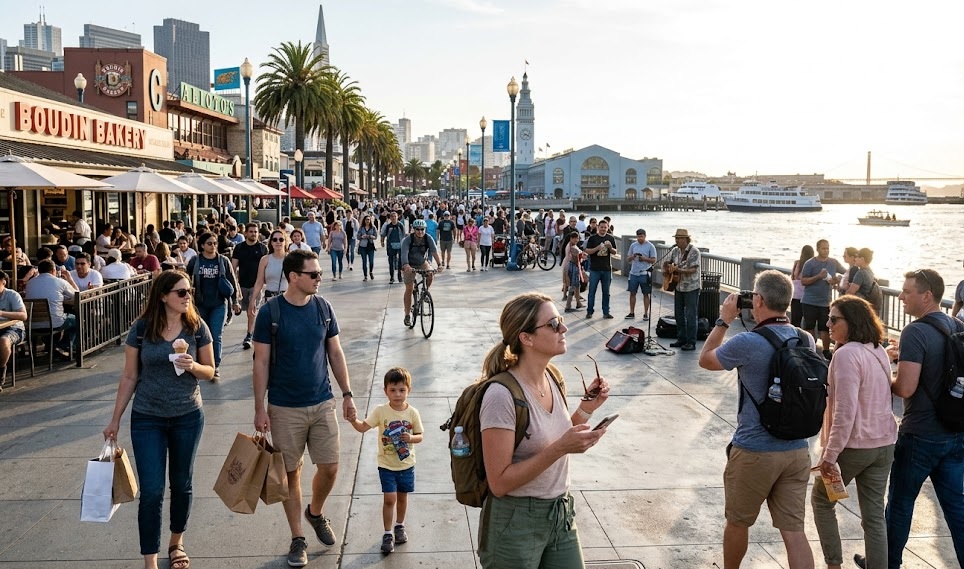
California has cemented its position as the top U.S. tourism state in 2025, with travel spending hitting a record $158.9 billion, up 1.7% from $156.2 billion in 2024 and edging past the previous peak. This marks the Golden State as not only the nation’s leading tourism destination by revenue but also a stable economic mainstay that continues to power local communities, small businesses, and hospitality‑cycle jobs even amid global headwinds.
Spending and visitation trends
Visitor spending growth in 2025 was driven mainly by domestic travelers, who accounted for about 82% of total travel expenditure, underscoring how in‑state and inter‑state leisure and business trips are now the core engine of California’s tourism economy. International visitors, by contrast, spent about $25 billion, roughly $1 billion less than in 2024, dampened by a stronger‑dollar environment, softer airlift from some key markets, and lingering travel‑policy uncertainty.
Even with slightly lower international arrivals, California still recorded strong hotel and short‑term‑rental‑related spending, with guests staying in accommodations generating about $83 billion in 2025, up 2.7% year‑on‑year, signaling robust demand for overnight trips and longer‑stay experiences across urban, coastal, and wine‑country destinations. Some major cities such as San Francisco also reported visitor‑spending highs, with the city’s tourism revenue reaching $14.2 billion in 2025, surpassing its pre‑pandemic record in nominal terms though lagging slightly once inflation is factored in.
Job growth and industry resilience
The travel sector’s strength translated into job gains, with tourism adding roughly 4,350 travel‑related jobs in 2025, pushing total tourism employment in the state to about 1.2 million workers, a modest but stable 0.4% increase on the prior year’s figure. While this is still below the pre‑pandemic employment peak of around 1.2 million in 2019, it shows that the industry is on a steady‑recovery path, anchored by a mix of lodging, food service, transportation, and attractions, much of which cannot be outsourced and therefore helps support local‑payroll stability.
At the same time, analysts note that the sector entered 2025 with challenges, including a projected 1% year‑on‑year drop in total visitation to about 268 million trips, reflecting both a forecasted 9.2% reduction in international arrivals and a shift toward higher‑value, fewer‑but‑longer stays rather than sheer volume growth. Despite this, the combination of rising spending per trip and solid domestic‑travel demand has allowed California to maintain record‑high tourism revenue and employment levels, reinforcing its status as the U.S.’s travel‑economy leader.
Key Points
- California generated $158.9 billion in travel spending in 2025, the largest tourism‑industry revenue of any U.S. state and a 1.7% increase over 2024.
- Domestic travelers drove the majority of spending (about 82%), while international spending declined by about $1 billion to $25 billion, dragged down by a strong dollar and reduced airlift from some markets.
- The state added roughly 4,350 tourism‑related jobs in 2025, bringing total tourism employment to about 1.2 million, with much of the hiring concentrated in lodging, food service, and attractions.
- Hotel and short‑term‑rental guests alone contributed around $83 billion in spending, signaling strong demand for overnight stays across urban, coastal, and regional destinations.
Bottom Line: California’s record‑breaking 2025 travel year shows that U.S. tourism leadership is increasingly less about sheer international visitor count and more about high‑value domestic demand, long‑stay utilization, and a deeply embedded hospitality‑workforce base, with California acting as a blueprint for how large‑scale, diversified destination economies can sustain growth even when global arrivals softens.


More Stories
Illinois Tourism Hits Record Highs with 100M+ Visitors and $88B Impact in 2025
California Joins Michigan And Border Tourism Economies As US And Canada Tensions Trigger Nearly 35% Hospitality Fallout
Georgia Governor’s Tourism Conference 2026 to Focus on AI and Travel Trends