








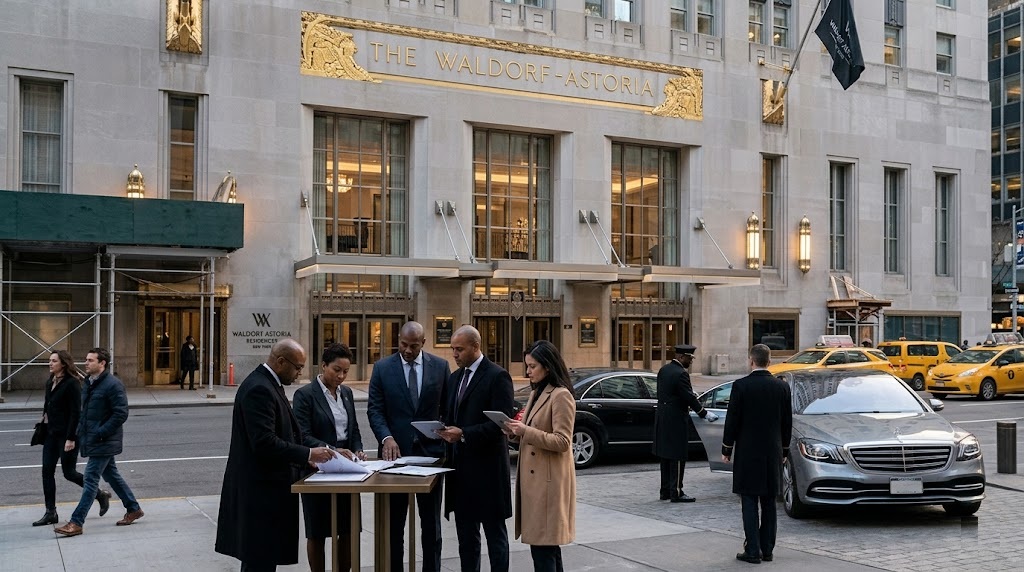
The Chinese owners of the Waldorf Astoria New York are preparing to put the landmark Park Avenue hotel up for sale, just months after it reopened from a multibillion‑dollar, eight‑year renovation. The state‑backed Dajia Insurance Group, which now oversees the asset following the fall of prior owner Anbang Insurance Group, is expected to list the property through New York real‑estate investment bank Eastdil Secured, which will market the 375‑room luxury hotel to a narrow pool of deep‑pocketed buyers.
The redevelopment reshaped the entire block between Park Avenue and Lexington Avenue into a mixed‑use layout with 375 hotel rooms and 372 private condominium units, while retaining the Waldorf’s grand public spaces, restaurants, and retail. Anbang originally bought the property in 2014 for $1.95 billion, then poured roughly $2 billion more into renovations and conversions, pushing total spending beyond $4 billion—a level the current owner now expects to recoup only partially, if at all. [webx% ecka] Some analysts and reports indicate that the deal may be signed at a significant loss, as broader Chinese capital exits the U.S. real‑estate market amid geopolitical and regulatory headwinds. [webx% xcka]
Hilton Worldwide continues to manage the hotel under a long‑term contract, preserving the Waldorf Astoria brand and flagship status in Manhattan even as the ownership and investment structure shifts. The sale marks both a milestone and a reckoning: the hotel’s sumptuous remodel restored its historical grandeur, but the transaction underscores a wider trend of Chinese state‑backed firms trimming high‑cost overseas assets, even when they are among the most iconic in the world. [webx% xcka][webx% xcka]
Key Points
- Chinese state‑backed Dajia Insurance Group is preparing to sell the Waldorf Astoria New York after an 8‑year, over‑$2 billion renovation.
- The property will be marketed by Eastdil Secured, with the 375‑room hotel and adjacent amenities included in the sale, while 372 condos are sold separately.
- The original $1.95 billion purchase plus massive renovation costs mean the sale is likely to be at a substantial loss, as China pulls back from U.S. property.
Bottom Line: The Waldorf Astoria New York’s return to the market highlights how even the most iconic luxury hotels can become financial albatrosses, as post‑makeover prestige clashes with heavy capital outlays and the pressures of geo‑economic realignment.



More Stories
From Prison Bars to Luxury Stars: HOSHINOYA Transforms Nara’s Historic Jail into 2026 Resort!
Taiwan’s Iconic Grand Hotel Taipei Hit by Cyberattack: Data Breach Alert!
1 Hotel Tokyo Debuts as Brand’s Asia Launch: Nature-Meets-Luxury in Akasaka!