









Greece is experiencing another powerful tourism season in 2026, but the surge in visitors is exposing growing pressure on the country’s most popular island destinations. International air arrivals reached 10.7 million during January–June 2026, up 3.8% year on year, showing that demand remains strong even as concerns grow over infrastructure, environmental capacity, and the economic sustainability of mass tourism.
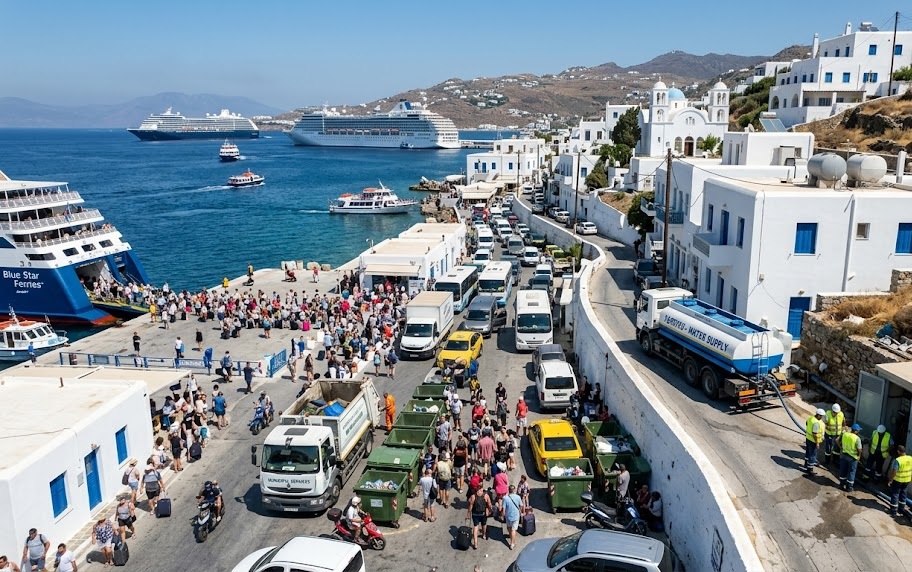
The challenge is becoming increasingly visible on smaller islands, where temporary summer populations can vastly exceed the number of permanent residents. On destinations such as Paros, Santorini, Mykonos, and other Cycladic islands, rising visitor volumes are placing additional pressure on waste management, water supplies, transport, housing, and essential public services. Nearly half of Greece’s tourism arrivals are concentrated on islands that account for only around 15% of the country’s land area, intensifying the strain on already limited infrastructure.
Tourism Growth Is Creating a Capacity Problem
Greece’s tourism success has become a double-edged story. More visitors generate revenue for hotels, restaurants, transport operators, retailers, tour companies, and local communities, but rapid growth can also push infrastructure beyond its intended capacity.
The issue is particularly serious on smaller islands where roads, waste facilities, water systems, electricity networks, and emergency services were designed primarily around permanent populations. During the peak summer months, the sudden increase in visitors can transform the scale of demand within a matter of weeks.
Paros Highlights the Infrastructure Challenge
The situation on Paros has brought the consequences of tourism pressure into sharper focus. The island has approximately 15,000 permanent residents but receives around one million passenger arrivals annually, creating an enormous seasonal gap between local population and visitor demand.
In 2026, a major wildfire that began around a landfill exposed serious weaknesses in the island’s waste-management system. The landfill had reportedly been saturated for years, while the closure of a recycling facility added further pressure as waste accumulated during the busy tourism season. The incident demonstrated how environmental risks and tourism infrastructure challenges can become closely connected.
Visitors Are Still Spending, but Growth Is Becoming More Complex
Greece’s tourism economy continues to expand, but higher visitor numbers are not automatically translating into proportionally higher revenue. In June 2026, arrivals increased 6.9% to 4.92 million, while travel receipts rose only 1.2% to €3.48 billion.
The difference was largely explained by a 6.2% decline in average spending per trip, suggesting that Greece may increasingly need to focus on the quality and economic value of tourism rather than simply pursuing higher visitor numbers.
Island Communities Face Rising Environmental Pressure
Overtourism is affecting more than roads and accommodation. Popular islands are dealing with increasing volumes of waste, pressure on natural resources, construction activity, and environmental degradation.
The combination of high visitor density, climate risks, water stress, and limited infrastructure creates a difficult challenge for local authorities. If these pressures continue unchecked, the very landscapes and communities attracting visitors could become increasingly difficult to protect.
Greece Moves Toward Stronger Tourism Management
Authorities are increasingly recognizing that continued tourism growth requires better destination management. Greece has begun introducing measures aimed at controlling excessive tourism pressure, protecting sensitive areas, and encouraging investment in more sustainable infrastructure.
The longer-term objective is not necessarily to reduce tourism, but to make growth more manageable. Encouraging travelers to visit lesser-known destinations, extending the season beyond the busiest summer months, and improving waste, water, transport, and energy infrastructure could help distribute the benefits of tourism more effectively.
The Next Challenge: Growth Without Overload
Greece remains one of Europe’s most attractive tourism destinations, and demand is unlikely to disappear. The challenge is ensuring that visitor growth does not overwhelm the communities and environments that make the country attractive in the first place.
For Greece’s islands, the future of tourism may increasingly depend on carrying capacity, infrastructure investment, sustainable development, and better distribution of visitors throughout the year. The country’s success will ultimately be measured not only by how many tourists it attracts, but by whether its destinations can continue welcoming them without sacrificing environmental quality or residents’ quality of life.
Key Takeaways
- Greece recorded 10.7 million international air arrivals in the first half of 2026, up 3.8% year on year.
- Nearly half of Greece’s tourism arrivals are concentrated on islands, placing significant pressure on destinations with limited infrastructure.
- Paros has highlighted the risks of rapid tourism growth, with around 15,000 permanent residents but roughly one million passenger arrivals annually.
- A major 2026 wildfire and landfill crisis on Paros exposed weaknesses in waste-management infrastructure.
- June arrivals increased 6.9%, while tourism receipts rose only 1.2%, showing that visitor growth is not translating proportionally into spending.
- Average spending per trip fell 6.2% in June, increasing the importance of attracting higher-value visitors.
- Greece is increasingly focusing on sustainable tourism, infrastructure investment, visitor distribution, and stronger management of overcrowded destinations.
Bottom Line
Greece is not facing an economic collapse; it is facing the growing infrastructure and sustainability costs of tourism success. Visitor demand remains strong, but the pressure on fragile island communities is becoming harder to ignore. With tourism numbers continuing to rise, Greece’s next challenge is to shift from simply attracting more visitors toward managing tourism intelligently, protecting its islands, improving infrastructure, and ensuring that long-term economic benefits do not come at the expense of local communities and the environment.


More Stories
GIC Acquires 16 Marriott-Operated Hotels in Japan for About $800 Million Amid Tourism Boom
Choice Hotels to Acquire Harvest Hosts for ~$130M, Expanding Into RV and Outdoor Travel
Hyatt’s Luxury Push Across the Americas Centers on Mexico Park Hyatt Trio and Unbound Growth