










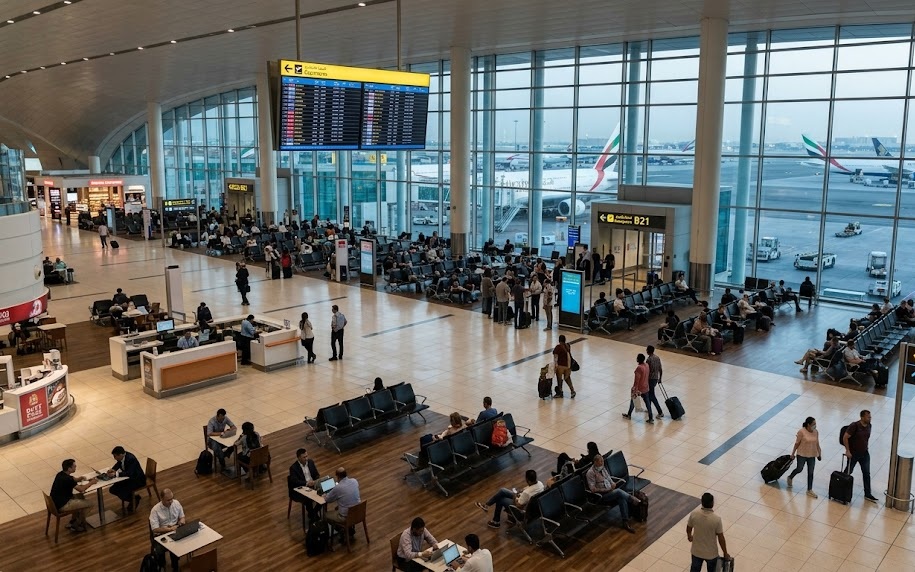
Dubai’s position as one of the world’s most important international aviation hubs is facing an unusual setback in 2026, with Dubai International Airport (DXB) recording a 31.3% decline in passenger traffic during the first half of the year. The airport handled 31.5 million passengers, compared with 46 million during the same period in 2025, as the conflict and resulting airspace restrictions across the Gulf disrupted international travel.
The impact has extended beyond Dubai itself, affecting international airlines and travel markets that depend heavily on Gulf connections. UK travelers and European aviation markets have been particularly exposed, with carriers including British Airways and Lufthansa remaining cautious about restoring some regional services. At the same time, European airports recorded overall passenger growth, showing that travelers are still moving in large numbers but are increasingly shifting routes and destinations in response to geopolitical conditions.
Dubai’s Aviation Hub Takes a Major Hit
DXB recorded 150,600 aircraft movements during the first half of 2026, down 32.1% year over year. Cargo volumes also declined by 28.7%, while baggage volumes fell 28%. These figures demonstrate that the disruption has affected not only holidaymakers but also business travel, connecting passengers, freight operations, and the wider aviation ecosystem.
The scale of the decline is particularly significant because Dubai normally relies on its enormous international transfer market. Its geographic position allows travelers from Europe, Asia, Africa, and the Americas to connect through the Gulf, meaning disruptions to regional airspace can quickly affect journeys far beyond the Middle East.
UK and European Airlines Remain Cautious
The UK has been closely connected to Dubai through major airlines and high-volume leisure and business routes. However, British Airways has remained cautious about restoring some Middle Eastern services, while other European carriers have also extended suspensions or adjusted schedules.
The wider European aviation market has remained comparatively resilient. Airports across Europe recorded 2.6% passenger growth during the first half of 2026, although growth slowed significantly in the second quarter as the Middle East conflict affected international traffic and airline capacity. The UK recorded only 0.4% growth, while Spain and Italy performed more strongly.
Travelers Are Redirecting Their Holidays
The disruption is also changing traveler behavior. Some European holidaymakers are choosing destinations closer to home, particularly across Spain, Italy, Greece, and other European markets, rather than relying on Middle Eastern hubs for long-haul travel.
This shift is benefiting European destinations that offer strong air connectivity and shorter travel times. For tourism businesses, however, it also means that travel demand is being redistributed rather than simply disappearing.
Dubai Begins Its Recovery
Despite the dramatic first-half decline, Dubai Airports is reporting signs of recovery. Passenger numbers increased steadily through the second quarter, rising from 3.5 million in April to 5 million in June, while airline capacity has gradually returned.
By the end of June, DXB was connected by almost 50 international airlines to 217 destinations across 99 countries, while load factors were approaching 2025 levels. Dubai Airports expects stronger momentum in the second half as airlines restore frequencies, international transfer traffic improves, and travel conditions stabilize.
Global Connectivity Remains Dubai’s Biggest Advantage
Dubai’s long-term strength remains its extraordinary connectivity. Even after one of the most difficult operating periods in the airport’s history, the hub continues to connect hundreds of destinations across the globe.
The airport is also investing in biometric systems, self-service technology, passenger-flow improvements, and upgraded facilities, reinforcing its ambition to maintain its position as a leading global aviation gateway once international traffic fully recovers.
Key Takeaways
- Dubai International Airport recorded a 31.3% passenger decline in the first half of 2026, handling 31.5 million passengers compared with 46 million a year earlier.
- Aircraft movements fell 32.1%, while cargo volumes declined 28.7%, showing the disruption affected both passenger and freight operations.
- UK and European airlines have remained cautious about restoring some Middle Eastern routes, reflecting continued uncertainty across the region.
- European airports still recorded 2.6% overall passenger growth, although the pace slowed sharply during the second quarter.
- European travelers are increasingly favoring closer destinations, with Spain, Italy, Greece, and other European markets benefiting from redirected demand.
- Dubai’s traffic began recovering during Q2, with monthly passenger volumes rising from 3.5 million in April to 5 million in June.
- DXB remains connected to 217 destinations across 99 countries, demonstrating the resilience of Dubai’s global aviation network.
Bottom Line
Dubai’s 31.3% first-half passenger decline marks one of the biggest disruptions the global aviation hub has faced in years, but it does not signal a collapse in Dubai’s tourism or connectivity model. The Gulf conflict temporarily redirected international travel and forced airlines to reduce capacity, while European destinations captured some of the displaced demand. With airlines gradually restoring services and passenger volumes already strengthening, Dubai enters the second half of 2026 focused on recovery, connectivity, and maintaining its position as one of the world’s most important global travel hubs.



More Stories
Canadian Travelers Face Boarding Disruption at Houston Airport
Europe Flight Disruptions Hit Madrid and Other Routes
Emirates, Air Arabia and Riyadh Air Transform Gulf Travel in 2026