











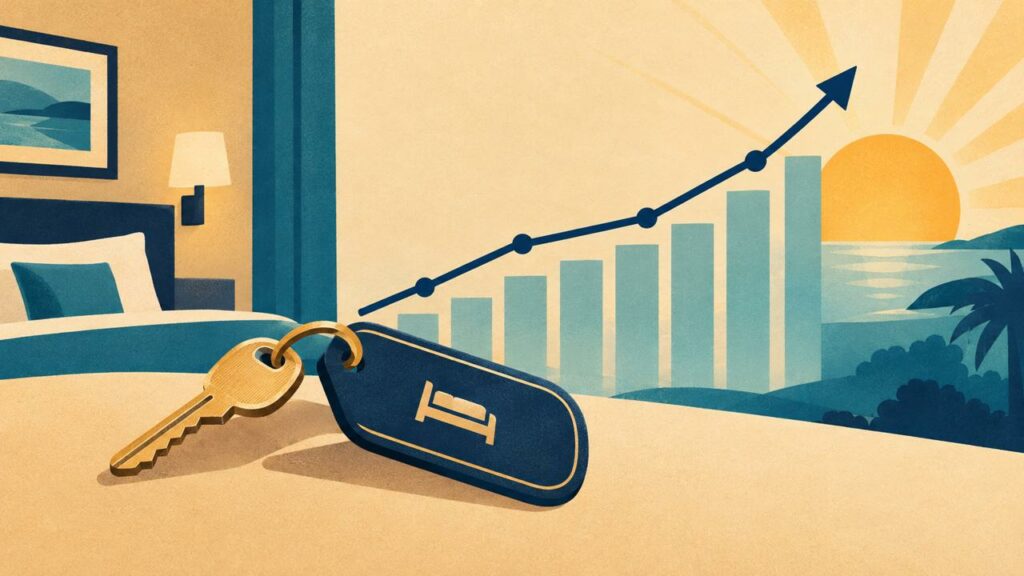
US hotel revenue per available room (RevPAR) rose 11% in September. That is the biggest monthly gain since February 2023. Both occupancy and average daily rate (ADR) were higher.
Why both occupancy and rate matter
RevPAR combines how many rooms were sold with how much each room earned. A gain driven only by rate can mean fewer guests are booking. A gain driven only by occupancy can mean hotels are discounting. When both rise, demand is strong enough to support fuller hotels at better prices.
What this means for pricing power
Pricing power returned across many markets. Owners and revenue managers could raise rates without losing guests. That is a useful signal for planning the end of the year and the first months of 2027.
Caution on costs
Revenue is not profit. Wages, insurance, taxes, utilities and distribution fees have all risen. A strong month helps, but owners should check whether higher costs absorb the gain. Flow-through, the share of added revenue that reaches profit, is the number to watch.
Questions to ask your team
- Which segments and days of the week drove our September gain?
- Did we raise rates fast enough, or did we leave money on the table?
- How much of the extra revenue passed through to profit?
- Are we ready to hold rates if demand cools?
The bigger picture
One strong month does not make a year. September’s comparison may have been affected by timing of events and holidays. Use it as a signal, then confirm with the following months before you commit to larger budget changes.
How RevPAR is built
RevPAR is occupancy multiplied by average daily rate. It is a compact measure of how well a hotel fills rooms and how much it earns from them. A rise in RevPAR driven by occupancy alone suggests more demand. A rise driven by rate alone suggests pricing power. A rise driven by both, as in September, is the strongest signal, because it means demand grew enough to let hotels raise prices without losing guests.
Putting an 11% gain in context
The size of the gain stands out because it is the biggest monthly increase since February 2023. A single month can be moved by calendar effects, such as the timing of holidays or events, and by comparisons with a weak prior-year month. One month does not make a trend. It does, however, tell owners that the underlying demand can still deliver strong gains when conditions line up.
Questions the number cannot answer
- Where was the growth? National figures hide big differences between markets. Some cities and segments may have grown much more than 11%, others less.
- Which segments? Luxury, upper upscale, midscale and economy often move differently.
- What drove it? Events, group business, leisure demand and international arrivals have different staying power.
- How much was a comparison effect? A weak base month makes growth look larger.
Turning a strong month into a plan
Strong months are a chance to be disciplined. Review pricing for upcoming periods and check whether you are leaving revenue on the table. Look at your booking pace for the next ninety days and compare it with last year. If you are ahead, hold rates. If you are behind despite a strong market, look at your distribution, reviews and offers.
Then look at profit, not just revenue. Higher RevPAR only helps if costs stay under control. Review payroll, utilities, supplies and distribution costs to see how much of the gain reaches the bottom line.
Caution on costs
Wages, insurance, taxes and maintenance have all risen. A strong revenue month can mask thin margins. Owners should compare growth in revenue per room with growth in cost per occupied room. If costs are rising faster, higher RevPAR will not bring higher returns.
What to watch next
Look at the next month’s data to see whether the gain was sustained. Check forward bookings and group pace, which are early signs of demand. And pay attention to what happens to rates in markets with new supply, since that is where pricing power will be tested first.




More Stories
Spain Tourism 2030 Sets a New Direction for Travel
Brazil And Argentina Power September Travel Growth
London Showcases Europe’s Booming Attractions Industry