










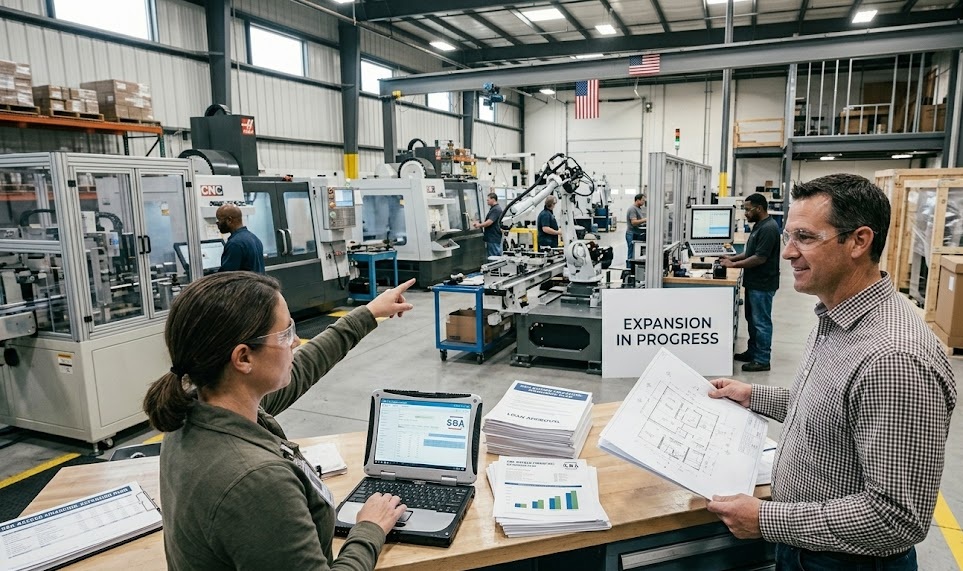
The American Hotel Owners Association (AHOA) is drawing attention to recent Small Business Administration (SBA) moves that expand access to 7(a) and 504 financing for small‑business manufacturers, including property‑owning and asset‑heavy hotel operators that qualify as manufacturers or meet public‑policy goals. The association is framing the changes as a critical capital‑access upgrade, especially for members who rely on long‑term, fixed‑rate financing to buy, build, or modernize physical assets such as hotels, warehouses, and franchise‑related infrastructure.
What the SBA has done
Under the SBA’s current framework, the standard 504 loan cap is $5 million, but manufacturers (NAICS 31, 32, 33) and certain energy‑efficiency or green‑public‑policy projects can access up to $5.5 million in SBA funds per project, with the 504 layer covering up to about 40% of total project costs. The 7(a) program complements this by offering up to $5 million in SBA‑backed financing for a broader range of uses, including working capital, leasehold improvements, acquisitions, and refinancing, with terms up to 25 years depending on the use of proceeds.
For qualifying manufacturers, the SBA effectively combines 7(a) and 504 exposure, letting businesses stack SBA‑backed capacity beyond the generic thresholds, provided the total SBA guarantee stays within framework limits and project‑size or job‑creation goals are met. This is particularly relevant for hotel‑related manufacturers and capital‑intensive builders, who can now use 504 for real‑estate or major‑equipment purchases and 7(a) for working capital or fit‑out, all under a single coordinated SBA umbrella.
Why AHOA cares
AHOA is highlighting the policy shift because many small‑business‑owned hotels and related manufacturers operate at the edge of traditional‑lending capacity, with heavy upfront asset costs and thin equity cushions. By pointing to the higher 504 caps for manufacturers and the flexible 7(a) rules, AHOA wants its members to know that SBA‑backed credit lines can now stretch further, supporting property acquisition, major renovations, energy‑efficiency upgrades, and new‑build projects without forcing owners into purely non‑SBA, high‑cost debt structures.
For the broader industry, the move signals that SBA policy is tilting toward fixed‑asset, job‑creating, and green‑investments, which dovetails with hotel‑sector trends such as energy‑retrofitting older properties, upgrading F&B and MICE infrastructure, and expanding limited‑service models in secondary markets.
Key Points
- The SBA allows 504 loans up to $5.5 million for manufacturers and certain green‑energy projects, far above the standard $5 million cap, and combines this with 7(a) access up to $5 million in SBA‑backed financing.
- AHOA is spotlighting this combined 7(a) and 504 capacity as a tool for small‑business hotel owners and related manufacturers to finance acquisitions, renovations, and energy‑efficiency upgrades more affordably.
- The policy shift supports longer‑term, fixed‑rate, asset‑heavy lending, which aligns with the sector’s need for stable capital as it modernizes older stock and invests in sustainability‑driven upgrades.
Bottom Line: AHOA’s emphasis on the SBA’s higher 7(a) and 504 limits for manufacturers underscores a growing opening for capital‑hungry, small‑business‑owned hotel operators to tap into federal‑backed, long‑term financing that can fund major physical and operational upgrades without tanking leverage or forcing over‑reliance on expensive, short‑term debt.




More Stories
Aspen Elevates New York Luxury Travel with The Nell at Rockefeller Center
Iran, Iraq, Lebanon, Syria, Yemen and Palestine Under Strict Level 4 “Do Not Travel” Warnings
United States Hotel Industry Enters a Powerful New Era as Guest Satisfaction Soars