








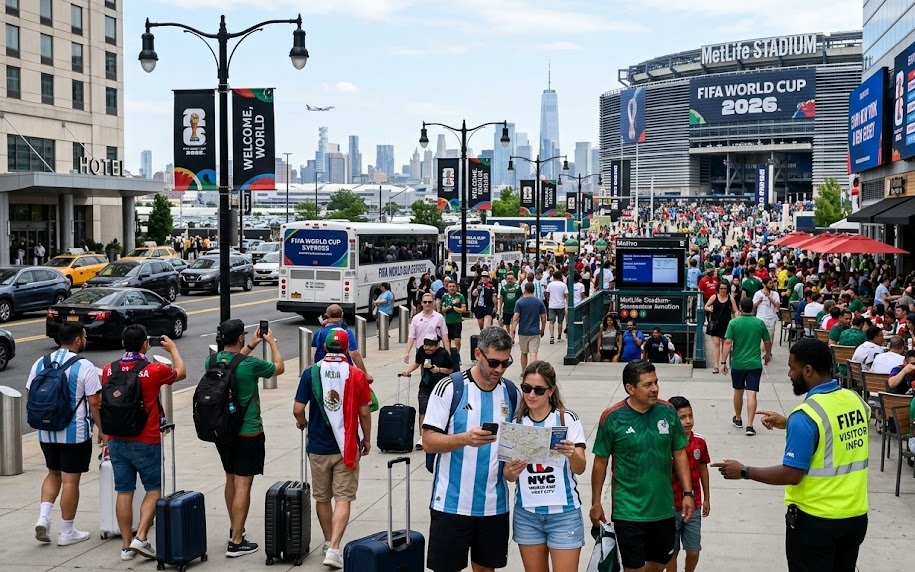
The FIFA World Cup 2026 is reshaping global summer travel as millions of fans, tourists, and sports enthusiasts flood across USA, Canada, and Mexico, creating unprecedented tourism realignment across the three host nations. Expected to bring over 1 million foreign tourists to U.S. stadiums alone, the tournament has triggered massive event-driven bookings, late travel decisions, and intense pressure on destination hotspots like Los Angeles, New York, Dallas, Toronto, Mexico City, Guadalajara, and Atlanta. The World Cup represents the largest sporting event in history with 48 teams competing across 16 cities, fundamentally shifting how travelers plan summer trips and driving tourism revenue to record levels across North America.
The tournament’s impact extends far beyond match days, with host cities experiencing accommodation shortages, flight price surges, and transportation bottlenecks as demand concentrates around stadium locations. Hotels in proximity to venues are seeing prices double or triple compared to normal rates, while last-minute bookings are becoming increasingly difficult due to limited availability. Travelers are making late decisions to secure World Cup tickets and accommodations, creating a surge in demand that traditional tourism operators struggled to anticipate. The realignment has created high-pressure hotspots where infrastructure cannot meet the sudden influx, forcing authorities to implement emergency crowd management and transportation protocols.
Major tourism trends emerging include package deals combining matches with regional tourism, multi-city itineraries covering multiple host countries, and extended stays to maximize the World Cup experience. Visitors are choosing destinations based on match schedules rather than traditional appeal, with secondary cities like Kansas City, Cincinnati, and Monterrey gaining unexpected tourism momentum. The event-driven booking surge has also led to increased competition for flights, with international routes to North America seeing capacity increases of 35-40% compared to 2025 levels, while domestic connections within host nations are experiencing similar strain.
Key Points
- Over 1 million foreign tourists to U.S. stadiums — FIFA World Cup 2026 bringing massive tourism surge across USA, Canada and Mexico with 48 teams in 16 cities [World Cup tourism]
- Major hotspots: LA, NYC, Dallas, Toronto, Mexico City — Host cities experiencing accommodation shortages, flight price surges, and transportation bottlenecks as demand concentrates [hotspot destinations]
- Hotel prices doubling or tripling — Properties near venues seeing 2-3x rate increases compared to normal; last-minute bookings becoming difficult due to limited availability [accommodation surge]
- Late travel decisions dominating — Fans making last-minute bookings to secure World Cup tickets and accommodations, creating demand surge traditional operators struggled to anticipate [late bookings]
- Package deals with regional tourism — Travelers choosing multi-city itineraries covering multiple host countries, extended stays to maximize World Cup experience [package trends]
- Flight capacity up 35-40% — International routes to North America seeing dramatic capacity increases; domestic connections within host nations experiencing similar strain [flight demand]
Bottom Line
The FIFA World Cup 2026 is driving massive tourism realignment across USA, Canada, and Mexico, with over 1 million foreign tourists expected at U.S. stadiums and 48 teams competing across 16 cities. Host cities like Los Angeles, New York, Dallas, Toronto, and Mexico City face accommodation shortages, flight price surges, and transportation bottlenecks as demand concentrates around stadium locations. Hotels near venues are seeing prices double or triple, while late travel decisions are creating unprecedented booking pressure that traditional operators couldn’t anticipate. The tournament is driving package deals combining matches with regional tourism, multi-city itineraries across host countries, and extended stays, with secondary cities like Kansas City, Cincinnati, and Monterrey gaining unexpected momentum.



More Stories
GIC Acquires 16 Marriott-Operated Hotels in Japan for About $800 Million Amid Tourism Boom
HVS: U.S. Hotel RevPAR Up Over 10% Mid-September as Nearly 1,000 Hotels Sold in H1 2026
Choice Hotels to Acquire Harvest Hosts for ~$130M, Expanding Into RV and Outdoor Travel