










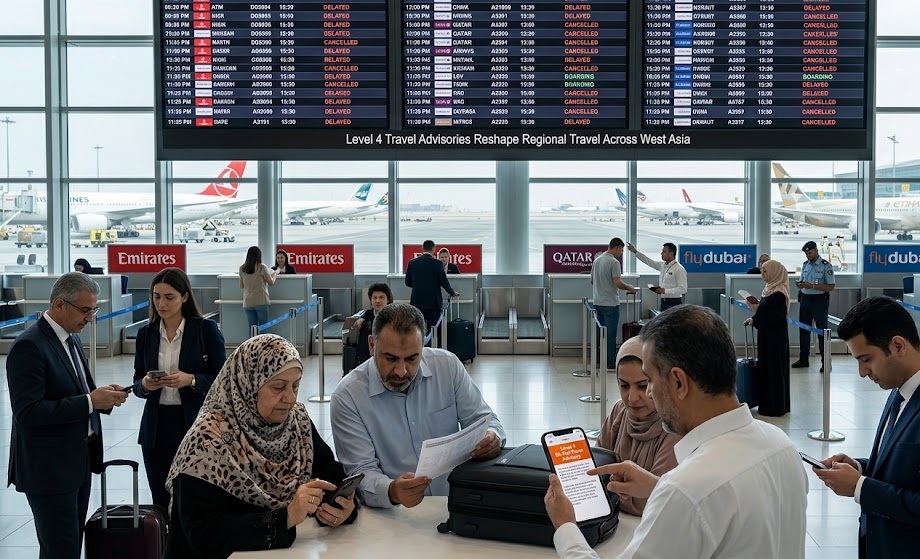
West Asia is experiencing a major transformation in its tourism landscape as escalating geopolitical tensions, armed conflict and widespread security concerns continue to impact travel across the region. Countries including Iran, Iraq, Lebanon, Syria, Yemen and Palestine remain subject to Level 4 “Do Not Travel” advisories from multiple governments, reflecting the highest level of travel warning. These advisories cite ongoing conflict, terrorism, civil unrest, kidnappings and the potential for sudden military escalation, making travel to several parts of the region increasingly challenging.
The impact is extending well beyond the affected destinations. Airspace closures, flight diversions and operational restrictions have forced airlines to reroute services, suspend select routes and revise schedules to avoid high-risk areas. Travelers are facing longer journey times, last-minute cancellations and increased travel costs, while airlines continue to adapt operations in response to rapidly changing security conditions. The disruption is also affecting business travel, religious pilgrimages and regional connectivity, creating uncertainty across the broader Middle East travel market.
For the tourism industry, the consequences are becoming increasingly visible. Historic cities, UNESCO-listed heritage sites, religious destinations and cultural attractions that once welcomed millions of international visitors are witnessing reduced tourist arrivals as safety concerns outweigh travel demand. Hotels, tour operators and local businesses that depend heavily on international tourism are also feeling the economic impact, while neighboring destinations considered more stable are seeing growing interest from travelers seeking safer alternatives within the region.
Despite the challenges, tourism stakeholders remain hopeful that improved regional stability, the reopening of restricted airspace and the gradual easing of travel advisories will help restore traveler confidence. Until then, industry experts recommend that travelers closely monitor official government advisories, airline notifications and local security developments before making travel plans. With the situation continuing to evolve, safety, flexibility and informed decision-making remain essential for anyone planning to visit West Asia.
Key Points
- Iran, Iraq, Lebanon, Syria, Yemen and Palestine remain under Level 4 “Do Not Travel” advisories from several governments.
- Escalating conflict and security risks continue to disrupt tourism across West Asia.
- Airspace restrictions and flight rerouting are causing delays, cancellations and higher travel costs.
- Business travel, religious pilgrimages and leisure tourism are all being affected by the evolving security environment.
- Hotels, tour operators and local tourism businesses are experiencing declining international visitor numbers.
- Tourism recovery will largely depend on regional stability, the reopening of airspace and renewed traveler confidence.



More Stories
GIC Acquires 16 Marriott-Operated Hotels in Japan for About $800 Million Amid Tourism Boom
HVS: U.S. Hotel RevPAR Up Over 10% Mid-September as Nearly 1,000 Hotels Sold in H1 2026
Choice Hotels to Acquire Harvest Hosts for ~$130M, Expanding Into RV and Outdoor Travel