









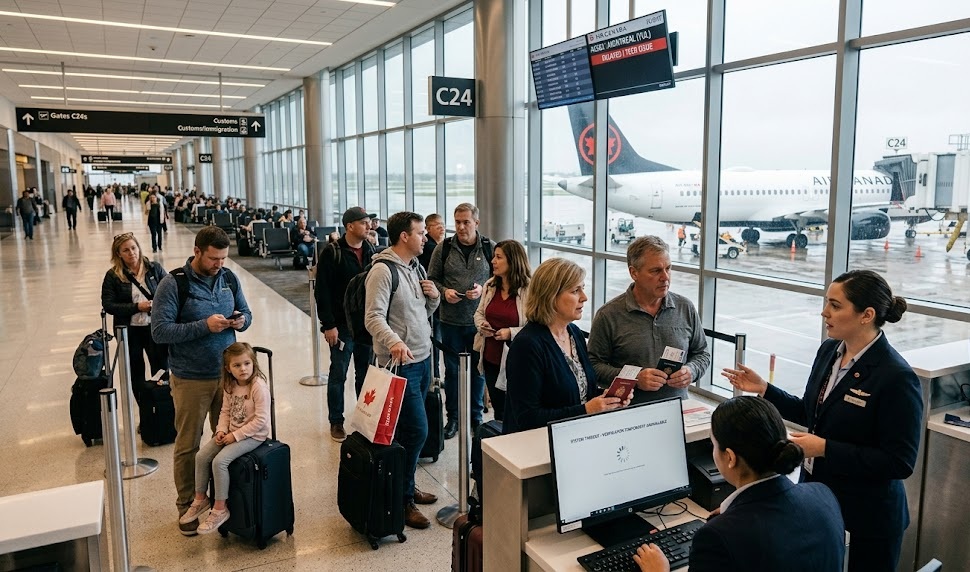
Canadian travelers at Houston’s George Bush Intercontinental Airport faced an unexpected boarding disruption after a technical problem affected the system used to verify passengers’ Canadian immigration status. Several passengers with valid Canadian passports were reportedly unable to board their flights home, turning what should have been a routine return journey into an unexpected airport ordeal.
The issue appears to have affected the electronic verification process used by airlines before passengers can be cleared for boarding. Travelers were reportedly shown a system message indicating that their immigration status was not approved for boarding, despite holding valid documents. The incident highlights how heavily international air travel now depends on real-time digital checks between airlines and government border systems.
Valid Passports Were Not Enough
For affected passengers, the most frustrating part was that their travel documents were reportedly valid. The problem was not necessarily with the passports themselves, but with the electronic verification system used to confirm eligibility before boarding.
One traveler reported that airline staff described the issue as a system bug affecting multiple passengers, with the problem later resolved and rebooking made possible. The disruption demonstrates how a technical failure can temporarily create a mismatch between a traveler’s physical documentation and the information available to an airline’s boarding system.
Airline Staff Forced to Handle the Fallout
When automated immigration verification fails, airline employees may have limited ability to override the system immediately. This can leave passengers waiting while staff attempt to determine whether the issue is related to documentation, government databases, or the airline’s own systems.
For travelers, the consequences can include missed flights, rebooking, additional airport waiting time, and uncertainty over whether they will be allowed to board. Even after a technical problem is corrected, passengers may still need to be accommodated on later flights if their original departure has already closed.
The Wider Risk of Digital Border Systems
The incident highlights a broader challenge facing modern aviation: greater digital integration can make travel faster, but system failures can also create immediate disruptions.
Airlines increasingly rely on electronic systems to verify passports, immigration status, travel authorizations, and other requirements before allowing passengers to board international flights. When those systems become unavailable or return incorrect information, travelers can be affected even when their physical documents are completely valid.
Why This Matters for Canadian Travelers
The disruption is particularly significant because Canadian citizens generally have a straightforward process for returning to Canada. A system failure affecting the verification of Canadian travelers can therefore create confusion at the departure airport, particularly when passengers are told that their status cannot be electronically confirmed.
For travelers flying internationally, the incident is another reminder to keep passports and travel documentation readily available and allow extra time at the airport, especially when traveling through major international hubs.
Key Takeaways
- Canadian travelers at Houston Airport faced boarding problems after an electronic immigration verification system experienced a technical issue.
- Several passengers reportedly had valid Canadian passports but were temporarily unable to board flights back to Canada.
- Airline staff reportedly described the problem as a system bug affecting multiple passengers.
- The disruption demonstrates the growing dependence of international aviation on real-time digital immigration and document verification systems.
- A technical failure can lead to missed departures, rebooking, longer airport waits, and significant passenger frustration.
- The incident highlights the importance of reliable backup procedures when automated border and immigration systems experience outages.
Bottom Line
The Houston Airport disruption shows how a failure in digital immigration verification can stop travelers from boarding even when their passports are valid. While the issue was reportedly resolved and affected passengers were able to make alternative arrangements, the incident highlights a growing challenge for modern aviation: as border and airline systems become increasingly digital, technology reliability and effective backup procedures are becoming just as important as the travel documents passengers carry.



More Stories
Spire Hospitality Launches AI-Driven Strategic Asset Performance Division for Hotel Owners
Hilton, Accor, Wyndham CEOs Split on AI Jobs as Voice Agents Lift Hotel Bookings
HyperGuest Lands $25M From Apax as Hotel Distribution Bets on Direct Connectivity and AI