










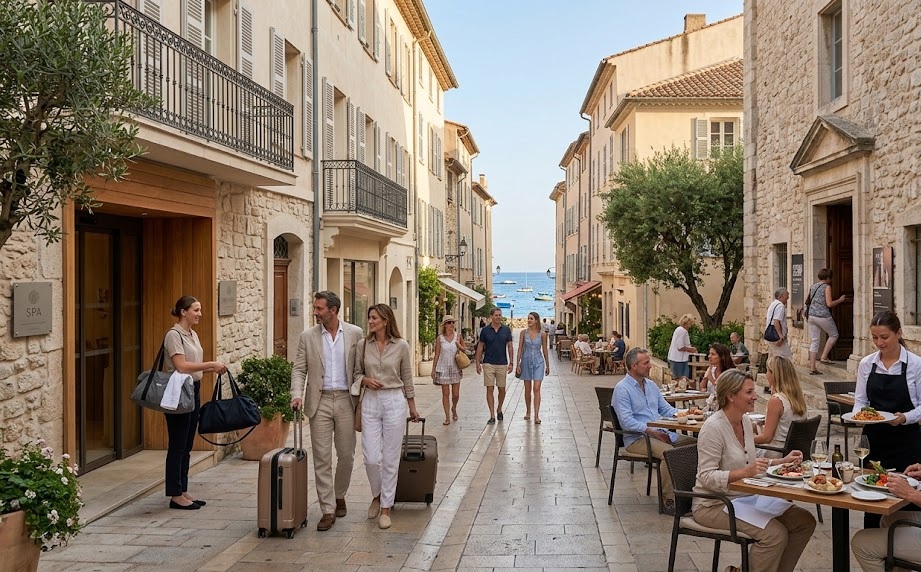
France is heading toward another record year for tourism revenue, with strong demand from European markets helping offset a more uneven summer for domestic travel. Italy and Germany are among the important source markets supporting France’s tourism performance, while growing demand from North America and other long-haul destinations is adding further momentum.
France recorded €40 billion in international tourism receipts during the first half of 2026, up 7% from the same period in 2025, according to Atout France. The country’s tourism balance also strengthened, with the travel surplus reaching €14.4 billion, an increase of 23% year over year.
France Targets €80 Billion In Tourism Revenue
The latest figures put France on track to reach around €80 billion in international tourism receipts in 2026, according to reporting based on government figures. That would establish another annual record after France generated €77.5 billion in international tourism revenue in 2025.
The 2025 result was already a major milestone. France welcomed 102 million international visitors, compared with 100 million in 2024, while international tourism receipts climbed 9%.
The government has an even larger long-term target: €100 billion in international tourism revenue by 2030.
Italy And Germany Remain Important European Markets
European visitors continue to form the backbone of French tourism. In 2025, European markets including Italy, Spain, Belgium, the Netherlands and Germany accounted for a large share of overnight stays, with European overnight stays increasing 5%.
Germany was particularly strong, with German overnight stays in France increasing 9% in 2025. Italy also remained one of France’s important European visitor markets.
These neighbouring and relatively accessible markets are especially valuable because visitors can reach France by air, rail and road, making short breaks as well as longer holidays possible.
Germany’s Own Tourism Growth Adds To Cross-Border Demand
Germany’s tourism industry is also experiencing international growth in 2026, creating an interesting two-way European travel market.
Foreign visitors recorded 47.1 million overnight stays in Germany between January and July 2026, up 1% from the same period in 2025. July alone recorded 10.8 million international overnight stays, a 3.2% year-over-year increase.
The continued strength of intra-European travel is important for destinations such as France. European travellers can increasingly choose between multiple nearby destinations, and France’s accessibility gives it a strong position in this competitive market.
Italy Adds A Valuable Short-Haul Visitor Base
Italy is another important market for France because of the strength of cultural and leisure travel between the two countries.
The proximity of major Italian cities to France makes Paris, the French Riviera, the Alps, Provence and other French regions accessible for both short city breaks and longer holidays.
The French tourism industry is therefore benefiting not only from long-haul travellers but also from visitors who can make relatively easy cross-border trips. This creates resilience when demand from individual overseas markets becomes more volatile.
Long-Haul Markets Are Providing Additional Momentum
While Italy and Germany remain important, France’s 2026 tourism growth is not dependent entirely on European visitors.
Atout France reported strong increases in air arrivals from several long-haul markets during the first half of the year. Mexico was up 14%, Canada 10% and the United States 2% compared with the corresponding period.
The first-quarter outlook was also encouraging, with air bookings from Mexico up 19%, China 17% and Canada 7% compared with 2025.
This diversification is important because it gives France multiple sources of international tourism demand rather than relying on one region.
Paris And Île-de-France Deliver Strong Summer Results
The Paris region remains central to France’s tourism performance.
Between June and August 2026, Paris Île-de-France welcomed approximately 13.3 million tourists, an increase of 3% compared with summer 2025. Tourist spending reached around €7 billion, growing twice as fast as visitor numbers at 7%.
The region benefited from major sporting, cultural and international events, while tourism growth also spread across all eight departments of Île-de-France.
The figures demonstrate the importance of spending rather than visitor volume alone. A 3% increase in tourists generated a 7% increase in spending, indicating stronger economic value per visitor during the summer period.
Tourism Spending Is Outpacing Visitor Growth
One of the most significant features of France’s current tourism performance is the relationship between visitor numbers and visitor spending.
France’s 2025 international visitor count increased by around 2%, from 100 million to 102 million. Yet international tourism revenue increased by 9%, reaching €77.5 billion.
The same pattern is appearing in 2026. International tourism receipts rose 7% during the first half, while Paris Île-de-France recorded spending growth more than twice its visitor growth during the summer.
For French tourism businesses, this means attracting visitors who spend more can be just as important as increasing total arrivals.
France Faces A More Uneven Domestic Market
The international picture is strong, but domestic travel has been more mixed.
Recent analysis reported that the number of French travellers taking summer trips declined 5.2% during July and August, while average trip duration also shortened. Domestic travellers have increasingly been choosing destinations within France, but overall summer travel activity was weaker than expected.
International visitors have therefore become increasingly important to maintaining tourism revenue growth.
The contrast also highlights why France is focusing on the shoulder seasons, when destinations can attract visitors outside the traditional July and August peak.
Shoulder Seasons Could Strengthen The Record
French tourism authorities and industry groups are looking toward autumn and winter to maintain momentum.
Reservations for November 2026 through April 2027 were described as encouraging, with already-booked business reaching €640 million, up 1.7% year over year. France itself was showing an 8% increase in this booking volume.
This could help reduce the industry’s dependence on the intense summer period while spreading tourism revenue more evenly throughout the year.
Mountain destinations are also becoming increasingly important outside the traditional summer season, giving France another opportunity to diversify visitor demand.
France’s Tourism Strategy Extends Beyond Visitor Numbers
France’s long-term tourism strategy is increasingly focused on economic value, sustainability and geographic distribution.
The country is targeting €100 billion in international tourism receipts by 2030 while also seeking to strengthen its position as a leading sustainable tourism destination.
That strategy requires more than simply attracting millions of additional visitors. It involves encouraging longer stays, increasing visitor spending, expanding tourism beyond Paris and major coastal destinations and strengthening demand during quieter periods.
European markets such as Italy and Germany can play an important role because their geographic proximity makes repeat visits and shorter trips more practical.
A Diverse Market Base Gives France Resilience
France’s current tourism performance demonstrates the value of having a broad international visitor base.
Germany and Italy contribute strong European demand, while the United States, Canada, Mexico and Asian markets provide additional long-haul opportunities. At the same time, Paris and other French regions continue to attract domestic and international visitors.
That diversity gives the French tourism industry multiple sources of demand even when geopolitical conditions, airline capacity or economic pressures affect individual markets.
Key Takeaways
- France recorded €40 billion in international tourism receipts in the first half of 2026, up 7% year over year.
- The country is targeting approximately €80 billion in international tourism revenue for 2026, following a record €77.5 billion in 2025.
- France welcomed 102 million international visitors in 2025, maintaining its position as the world’s most visited country.
- German overnight stays in France increased 9% in 2025, while Italy remained one of the country’s important European visitor markets.
- Long-haul demand is also strengthening, with first-half 2026 air arrivals from Mexico up 14%, Canada 10% and the United States 2%.
- Paris Île-de-France welcomed 13.3 million tourists between June and August 2026, with spending reaching €7 billion.
- Paris-region tourism spending increased 7%, compared with 3% growth in visitor numbers, showing the importance of higher visitor spending.
- France’s government has set a longer-term target of €100 billion in international tourism revenue by 2030.
- The country is increasingly looking to autumn, winter and shoulder-season travel to maintain tourism momentum beyond the summer peak.
Bottom Line
France’s tourism economy is moving toward another record year, with Italy and Germany among the European markets helping sustain demand. Strong international spending, rising long-haul arrivals and solid performance in Paris are offsetting a softer domestic summer and supporting the country’s ambition to reach €80 billion in tourism receipts in 2026. With a longer-term goal of €100 billion by 2030, France is increasingly focusing not only on attracting more visitors, but on encouraging higher spending, longer stays and year-round travel.



More Stories
GIC Acquires 16 Marriott-Operated Hotels in Japan for About $800 Million Amid Tourism Boom
HVS: U.S. Hotel RevPAR Up Over 10% Mid-September as Nearly 1,000 Hotels Sold in H1 2026
Choice Hotels to Acquire Harvest Hosts for ~$130M, Expanding Into RV and Outdoor Travel