









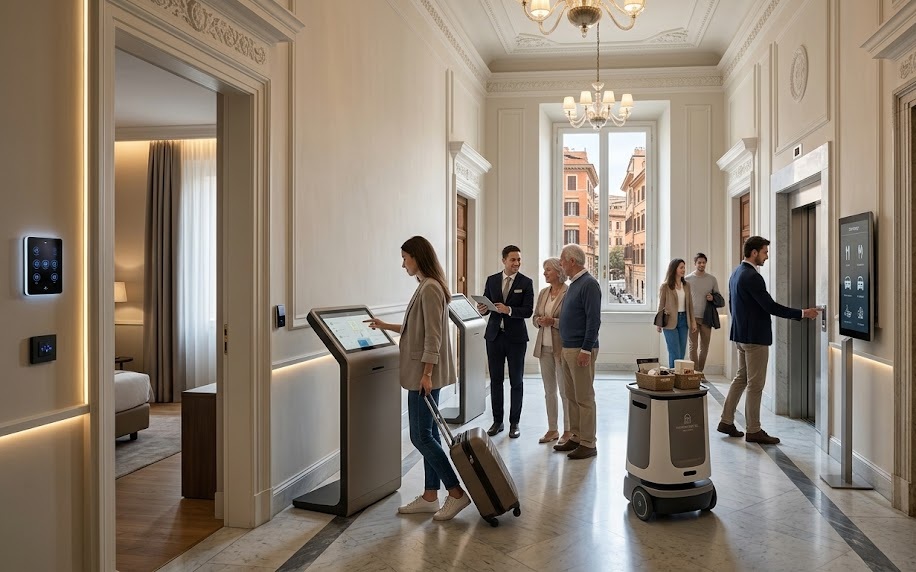
Artificial intelligence is rapidly changing Europe’s hotel industry, with destinations such as Rome and Berlin emerging as important centres of innovation in the way hotels attract guests, personalise stays and manage operations. From AI-powered travel discovery to automated guest services and data-driven tourism planning, technology is becoming increasingly integrated into the hotel experience.
The transformation is part of a wider shift across European tourism. At ITB Berlin 2026, industry leaders highlighted the rise of AI and agentic commerce, where intelligent systems can move beyond recommending hotels to helping travellers plan, compare and eventually book parts of their journeys.
AI Is Changing How Travelers Find Hotels
The traditional hotel search is increasingly being replaced by conversational travel planning. Instead of entering a destination, dates and room requirements into a conventional booking engine, travellers can increasingly ask AI systems for recommendations based on budget, interests, location, travel style and specific preferences.
This creates a major opportunity for hotels. Properties that are accurately represented across digital platforms and have strong, structured information can become easier for AI systems to discover and recommend.
Recent AI hotel recommendation data illustrates this emerging behaviour. In Berlin, AI assistants are already being tested across prompts covering business travel, couples, families, solo travel, luxury, budget accommodation and specific neighbourhoods.
Berlin Builds A Strong Digital Tourism Ecosystem
Berlin is particularly well positioned for this transition because the city’s tourism organisation is already investing heavily in data and AI-supported visitor services.
VisitBerlin operates a tourism data hub containing approximately 240,000 data records, while its website uses the AI-supported Berlynn chatbot to help visitors discover information. The city’s Convention Finder also uses AI search to connect conference and congress organisers with suitable providers.
The strategy goes beyond simply adding a chatbot. Berlin is attempting to create a more connected tourism ecosystem in which data can help distribute visitor flows, improve recommendations and make the visitor experience more personalised.
That could become increasingly important as cities try to balance growing tourism with residents’ quality of life.
Rome Benefits From AI-Powered Travel Discovery
Rome has an equally powerful advantage: enormous global demand combined with a huge and diverse hotel market.
For travellers, Rome presents thousands of possible combinations of accommodation, attractions, restaurants, neighbourhoods and experiences. AI can help simplify that complexity by matching hotels with individual traveller preferences.
A family looking for accommodation close to attractions may receive completely different recommendations from a business traveller seeking conference facilities or a luxury traveller searching for historic properties with premium services.
This shift makes personalisation one of the biggest potential benefits of AI for hotels.
Hotels Can Use AI Beyond The Booking Stage
The AI revolution is not limited to marketing and hotel discovery.
Hotels are increasingly exploring AI for guest communication, operational management, marketing, pricing, demand forecasting and personalised services. ITB Berlin’s 2026 innovation programme specifically highlighted AI applications in hotel operations, guest communication, quotations, marketing and sustainability.
For hotel operators, the attraction is clear. AI can process large amounts of information quickly and help staff identify patterns that would otherwise require significant manual work.
That could include predicting demand, identifying booking trends, responding to common guest questions or creating personalised recommendations.
Berlin’s Expanding Hotel Market Creates A Test Bed
Berlin’s hotel market provides a particularly interesting environment for this technological transition.
The city had more than 700 accommodation establishments in 2025, and its current hotel pipeline includes 56 projects, giving Berlin the largest hotel development pipeline in the DACH region, according to visitBerlin.
New properties and major renovations are arriving alongside technology-driven changes in the wider tourism ecosystem. Projects range from the 522-room Estrel Tower to new lifestyle and long-stay hotels, while established properties are investing in upgraded rooms, restaurants, event facilities and guest experiences.
A growing and increasingly diverse hotel market gives technology companies and operators more opportunities to test new approaches.
The Estrel Tower Symbolises Berlin’s Next Hotel Era
One of Berlin’s most significant upcoming developments is the Estrel Tower, which is scheduled for a soft opening in December 2026.
The 176-metre, 45-storey development will include 522 rooms, suites and serviced apartments, alongside co-working areas, a gallery, spa, restaurants, a skybar and substantial event space.
Although the tower is not simply an “AI hotel,” its combination of hospitality, business, events and digital infrastructure reflects the direction in which large urban properties are evolving.
The modern hotel is increasingly becoming a connected platform rather than simply a building containing rooms.
AI Could Make Hotels More Personal
One of the strongest arguments for AI in hospitality is its ability to make large-scale hotel operations feel more personalised.
A returning guest could potentially receive recommendations based on previous preferences, while a first-time visitor could be offered suggestions based on their itinerary, interests and available time.
For international cities such as Rome and Berlin, this could be especially useful. Visitors often arrive with limited time and enormous numbers of possible attractions.
AI can help turn that complexity into a more manageable itinerary while simultaneously directing spending toward restaurants, museums, neighbourhood businesses and hotel services.
The Rise Of Agentic Travel
The next stage may go further than recommendation engines.
The travel industry is increasingly discussing agentic AI, where AI systems can potentially take actions on behalf of travellers rather than simply provide information.
ITB Berlin’s 2026 discussions described a future in which AI agents could act as a traveller’s personal concierge, negotiator and logistics manager, potentially changing how accommodation and other travel services are discovered and purchased.
For hotels, this could fundamentally change digital marketing. Instead of competing only for visibility on traditional search engines and booking platforms, properties may increasingly need to become visible and attractive to AI agents.
Tourism Organisations Are Also Using AI
The change is not limited to hotel companies.
Destination management organisations are also adopting AI and advanced data systems to understand visitor behaviour and improve tourism planning.
Berlin’s use of its data hub, AI chatbot and AI-powered convention search demonstrates how destination organisations can use technology to connect travellers with relevant experiences while collecting and organising information about the city’s tourism ecosystem.
This could eventually help destinations address issues such as overcrowding by directing visitors toward less-visited neighbourhoods and attractions.
The Human Element Remains Important
Despite the rapid adoption of AI, the technology is unlikely to eliminate the importance of human hospitality.
Hotels still depend on service, cleanliness, atmosphere, staff interaction and trust. AI may help a traveller choose a property, but the actual stay determines whether that traveller returns or recommends it.
The most successful hotels may therefore be those that use AI to remove repetitive administrative work while allowing employees to spend more time on meaningful guest interactions.
That balance could become one of the defining challenges of the European hotel industry’s digital transformation.
Europe Enters A New Hotel Competition
The emergence of AI is creating a new competitive layer for European destinations.
Rome brings enormous cultural demand and a globally recognised hospitality market. Berlin combines a rapidly evolving hotel sector with one of Europe’s most advanced tourism-data strategies.
Together, they illustrate how the future hotel competition may no longer be based solely on location, price and room quality. Digital visibility, personalisation, data infrastructure and the ability to work with AI travel systems could increasingly influence where travellers stay.
Key Takeaways
- AI is reshaping European hospitality, moving from simple chatbots toward personalised recommendations, operational tools and agentic travel systems.
- Berlin is emerging as a major AI-driven tourism market, with an extensive tourism data hub, AI-supported Berlynn chatbot and AI-powered convention search.
- Berlin had more than 700 accommodation establishments in 2025 and currently leads the DACH hotel pipeline with 56 projects.
- AI hotel recommendations are increasingly being tailored around families, couples, business travellers, solo visitors, budgets and neighbourhood preferences.
- Rome’s enormous global tourism demand gives hotels a major opportunity to use AI for personalised discovery and visitor planning.
- AI is expanding beyond booking into guest communication, operations, marketing, pricing, sustainability and demand forecasting.
- The upcoming Estrel Tower in Berlin demonstrates the scale of investment taking place in the city’s evolving hotel market.
- The next phase of the transformation could involve AI agents planning and executing more parts of a traveller’s journey, potentially changing hotel distribution and marketing.
Bottom Line
Rome and Berlin represent two powerful sides of Europe’s emerging AI hotel revolution. Rome brings immense international tourism demand and a vast hospitality ecosystem, while Berlin is combining hotel investment with sophisticated tourism data and AI-powered visitor services. As travellers increasingly rely on artificial intelligence to discover, compare and plan accommodation, hotels that can combine technology with genuine human hospitality are likely to gain an important competitive advantage in Europe’s next generation of tourism.




More Stories
US China Open AI Safety Dialogue
Italy And Germany Help France Target Record Tourism Revenue
Illinois Tourism Hits Record Highs with 100M+ Visitors and $88B Impact in 2025