












Hawaii’s tourism industry is facing a striking paradox in 2026: visitors are spending more money overall, yet shorter stays and weaker summer demand are creating pressure across the visitor economy. During the first eight months of 2026, Hawaii welcomed 6.69 million visitors, up 1.8% from the same period in 2025, while total visitor spending reached $15.21 billion, an increase of 4.1%.
However, the headline growth hides a more complicated picture. In August 2026, visitor arrivals fell 5.6% year on year and total visitor spending dropped 9.7% to $1.59 billion. The contrast suggests that Hawaii is attracting travellers who can still afford the destination, but rising costs, weather disruptions and shorter holidays are changing how much time and money visitors contribute to the local economy.
More Spending Does Not Necessarily Mean More Visitors
Hawaii’s tourism strategy has increasingly focused on attracting visitors who generate greater economic value rather than simply maximising arrival numbers. The latest figures show why that approach can be attractive: during the first eight months of 2026, visitor spending increased faster than arrivals.
But the August downturn demonstrates the vulnerability of this model. When visitor numbers decline and travellers shorten their stays, higher daily spending may not be enough to compensate for fewer visitor days across hotels, restaurants, attractions, shops and transportation businesses.
Visitors Are Spending More Per Day
One of the strongest signals in the data is the increase in daily visitor spending. U.S. West visitors spent an average of $277 per person per day during the first eight months, compared with $242 a year earlier, while U.S. East visitors reached $314 per day, up from $284.
The increase reflects spending across categories including accommodation, food and beverages, transportation, shopping and entertainment. For Hawaii, this is positive because visitors are generating more economic activity each day they remain on the islands.
The problem is that travellers are staying for less time.
Shorter Holidays Are Changing The Equation
In June, for example, Hawaii welcomed slightly more visitors than a year earlier, but the average length of stay dropped from 8.86 days to 7.86 days. That one-day reduction helped push the average daily visitor census down by 11.2%, despite the small increase in total arrivals.
This creates the central paradox for Hawaii. A visitor spending more each day can appear economically valuable, but if that traveller leaves sooner, the total spending generated during the trip may not rise at the same rate.
For hotels, restaurants, tour operators and retailers, the number of visitor days can therefore be just as important as the number of arrivals.
August Shows The Pressure More Clearly
The August figures provide the clearest warning. Hawaii recorded 1.59 million visitors’ worth of spending, down 9.7% from August 2025, while arrivals declined 5.6%. The average daily census also weakened, reflecting fewer visitors staying on the islands at any given time.
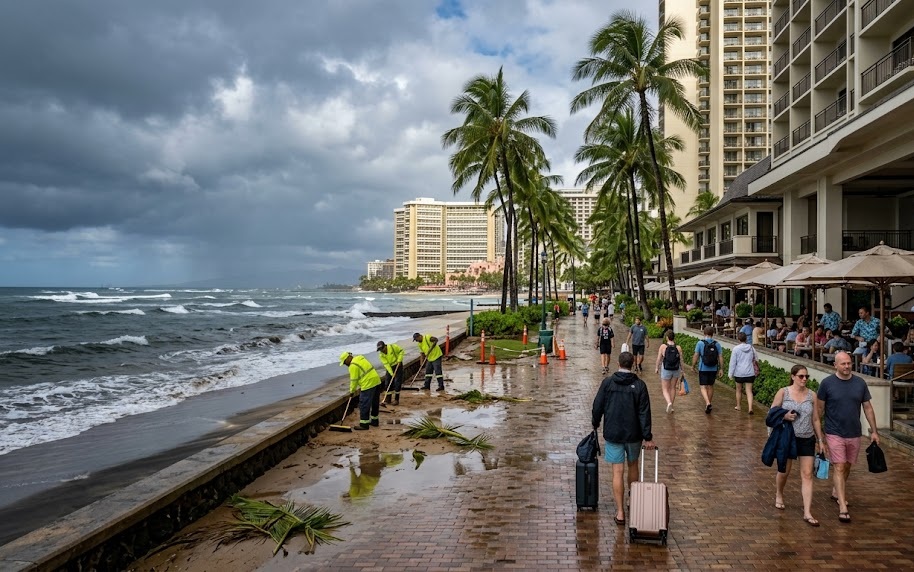
Several factors contributed to the weaker month. Lala and Moke, two severe weather systems, compounded an already soft summer season, while international markets including Japan, Oceania and Korea recorded lower arrivals and spending. The state also experienced further disruption from Hurricane Lowell in September, although its effect was not yet included in the August statistics.
U.S. Travelers Are Keeping The Market Resilient
The mainland United States remains Hawaii’s most important source of visitors and spending. During the first eight months of 2026, the U.S. West generated $7.35 billion in visitor spending, up 5.3%, while the U.S. East generated $4.97 billion, up 9.3%.
The U.S. East market has been particularly valuable because travellers from the region are spending an average of $314 per person per day. This higher daily spending has helped offset weakness in some international markets and demonstrates the importance of targeting higher-value long-haul domestic travellers.
International Markets Remain Uneven
International demand is producing a much more mixed picture. Japan, one of Hawaii’s historically important markets, recorded 477,032 visitors during the first eight months of 2026, only 0.8% above the previous year. Spending increased just 0.5% to $704.7 million.
Canada has been weaker, with visitor numbers falling 5% and spending declining 2.2% during the same period. However, August provided a rare positive signal, with Canadian arrivals and spending both increasing compared with August 2025.
The uneven international performance leaves Hawaii more dependent on the U.S. mainland market, particularly at a time when long-haul international travel can be influenced by currency movements, air capacity and broader economic conditions.
Maui’s Recovery Remains Complicated
Maui illustrates another side of Hawaii’s tourism paradox. During the first eight months of 2026, Maui recorded 1.82 million visitors, up 6%, while visitor spending reached $4.30 billion, an 8.1% increase.
Yet August was significantly weaker, with arrivals down 5.5% and spending falling 9.6% compared with August 2025. The average daily visitor census dropped more than 20%.
The figures show that Maui’s broader recovery is continuing, but demand remains uneven. The island is still balancing the need to rebuild its tourism economy with the wider social and economic challenges that followed the 2023 wildfires.
Oahu Faces A Different Challenge
Oahu, meanwhile, experienced a decline in August arrivals and spending even though its year-to-date numbers remained positive. The island recorded 3.86 million visitors during the first eight months, up 0.6%, while spending reached $6.79 billion, up 6.3%.
This again demonstrates how daily spending can rise even when visitor growth is limited. Oahu’s large tourism base gives it an important economic advantage, but maintaining demand will depend increasingly on delivering value as accommodation, transportation, food and other holiday costs remain high.
The Value Question Becomes More Important
Hawaii’s challenge is not simply attracting visitors. It is maintaining a balance between price, experience and length of stay.
Higher daily spending can strengthen tourism revenue, but consistently rising costs may encourage travellers to shorten their holidays, choose alternative destinations or reduce discretionary spending. For Hawaii, the long-term objective is therefore not simply to increase what visitors spend each day, but to ensure that the overall holiday experience continues to justify the cost.
That balance could determine whether the islands can maintain strong tourism revenue without creating a perception that Hawaii has become too expensive for the average traveller.
Key Takeaways
- Hawaii welcomed 6.69 million visitors in the first eight months of 2026, up 1.8% year on year.
- Total visitor spending reached $15.21 billion, increasing 4.1% during the same period.
- August was significantly weaker, with arrivals down 5.6% and spending down 9.7%.
- Daily spending has increased strongly, particularly among U.S. West and U.S. East visitors.
- Shorter stays are reducing the number of total visitor days, creating pressure despite higher spending per day.
- Maui’s year-to-date arrivals increased 6% and spending rose 8.1%, although August recorded declines.
- Oahu’s first-eight-month spending increased 6.3%, despite only 0.6% growth in arrivals.
- Japan remains relatively stable, while Canada has recorded weaker year-to-date demand.
- Weather disruptions and high travel costs are adding pressure to an already more selective tourism market.
- Hawaii’s central challenge is increasingly about finding the right balance between visitor volume, spending, affordability and length of stay.
Bottom Line
Hawaii’s tourism economy is growing on paper while simultaneously facing a serious demand challenge. Visitors are spending more per day and total year-to-date spending is higher, but shorter stays, weaker international markets and a difficult summer have reduced visitor days and pushed August spending sharply lower. The paradox is clear: Hawaii may not need more expensive tourism as much as it needs sustainable value that encourages travellers to stay longer. How the islands manage that balance could shape the next phase of Hawaii’s tourism recovery.




More Stories
Brazil And Argentina Power September Travel Growth
Switzerland Tops The World’s Most Expensive Nightlife Destinations
Asia Travel Faces Widespread Flight Disruption