










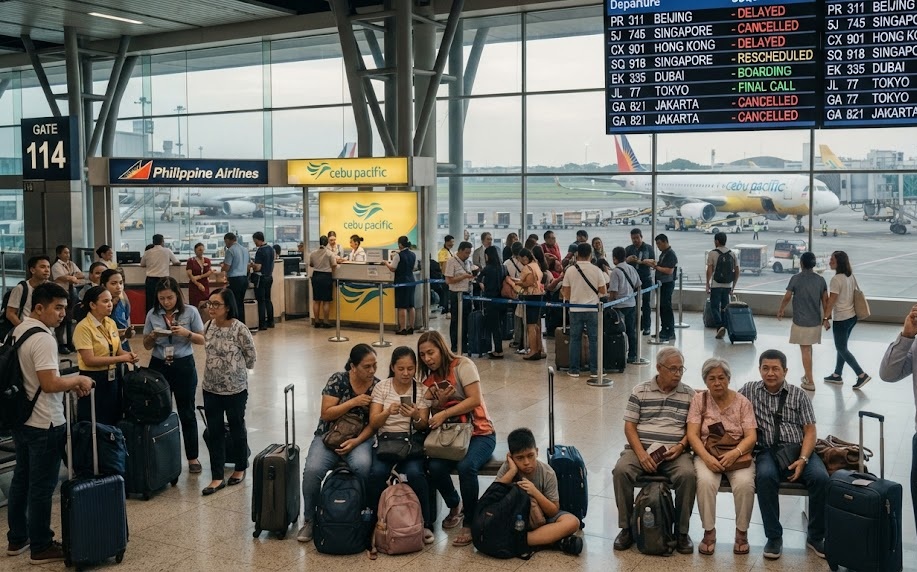
Air travel across Asia is facing widespread disruption, with 3,657 flights delayed and 224 canceled across a broad network of airports. The disruption is affecting passengers at major aviation hubs including Hanoi and Manila, adding pressure to an already busy regional air network as airlines work to keep aircraft, crews and connecting schedules moving.
The latest disruption comes as Asian aviation continues to handle high passenger volumes across some of the world’s busiest international gateways. Flight-tracking data currently shows significant delay activity at airports including Shanghai, Guangzhou, Delhi, Ho Chi Minh City, Jakarta, Jeddah and Dubai, demonstrating how quickly operational problems can spread across interconnected networks.
Hanoi and Manila Remain Important Regional Gateways
Hanoi’s Noi Bai International Airport and Manila’s Ninoy Aquino International Airport are particularly important for regional travelers because of their extensive connections across Southeast Asia and beyond.
The two cities also maintain a busy direct air link. Cebu Pacific, Philippine Airlines and Vietnam Airlines currently operate nonstop services between Hanoi and Manila, with the route averaging around four flights per day.
Live flight information shows services continuing between the two capitals despite the wider disruption. Vietnam Airlines and Philippine Airlines services on the route were operating on September 11, illustrating that airport-wide disruption does not necessarily mean every flight is affected.
Manila Faces Pressure From Weather and Operational Constraints
Manila’s aviation network remains particularly sensitive to heavy rain, low visibility and thunderstorms. Weather conditions can force aircraft to enter holding patterns, delay departures or temporarily restrict landing operations.
The airport has also faced additional operational complications in 2026. Aviation observers have highlighted the temporary unavailability of an instrument landing system on one of NAIA’s runways, meaning certain weather conditions can make approaches more difficult and increase the possibility of go-arounds or diversions.
For passengers, these conditions can produce delays even when the disruption initially appears limited to a particular runway or group of arriving aircraft.
Disruptions Stretch Across Major Asian Hubs
The latest figures reflect a broader pattern across Asia rather than an isolated problem at one airport.
Recent regional tracking data showed significant disruption at Delhi, Jakarta, Kuala Lumpur, Shanghai, Singapore, Manila and Hong Kong. In one earlier disruption period, Delhi recorded 361 delays, Jakarta recorded 224 delays and Kuala Lumpur recorded 223 delays, while Manila registered 94 delays and five cancellations.
Such numbers matter because these airports function as connecting hubs. A delayed aircraft arriving from one country can subsequently depart late for another destination, creating a chain reaction that affects passengers who may be hundreds or thousands of kilometres away from the original source of the disruption.
Weather Remains a Major Threat to Schedules
Across tropical and monsoon-affected parts of Asia, weather remains one of the most unpredictable factors for airline operations.
Heavy rainfall, thunderstorms, reduced visibility, strong winds and waterlogged airport surfaces can all affect take-offs and landings. Airlines may need to increase separation between aircraft, slow operations or temporarily hold flights until conditions improve.
For travelers, this means that a flight showing as scheduled several hours before departure can still be delayed later in the day. Weather disruptions are particularly difficult to predict because conditions can deteriorate rapidly.
Aircraft Rotations Create a Wider Ripple Effect
Another important factor is the interconnected nature of modern airline schedules.
An aircraft rarely operates just one flight during the day. The same plane may fly from Hanoi to Manila, continue to another Southeast Asian destination and then return to a major hub later that evening.
When the first flight is delayed, the aircraft may arrive late for its next assignment. Crew duty limits, gate availability and airport congestion can then create additional delays.
This is why passengers should not assume that a delay at another airport has no effect on their own journey. A disruption several hours earlier can eventually reach their flight through aircraft and crew rotations.
Connecting Travelers Face the Greatest Risk
Passengers with tight international connections are likely to feel the effects most strongly.
A delay of 30 or 60 minutes may be manageable for a traveler flying directly to a destination, but it can become much more serious when a passenger has a second flight departing shortly after arrival.
Missing a connection can lead to rebooking, longer airport waits, additional accommodation costs and missed hotel or tour reservations.
Travelers using major Asian hubs should therefore monitor their connection times carefully and check with airlines immediately if an incoming flight begins experiencing significant delays.
Hanoi-Manila Connectivity Continues Despite Regional Disruption
The Hanoi-Manila route also highlights the resilience of regional aviation. Multiple airlines continue to operate the connection, giving passengers several options between Vietnam and the Philippines.
Current schedules show Cebu Pacific, Philippine Airlines and Vietnam Airlines providing nonstop service, with flights generally taking around three hours and 50 minutes.
That connectivity is important for both leisure and business travelers, as Hanoi and Manila serve as major gateways for wider travel across Southeast Asia.
Passengers Should Check Individual Flight Status
Airport-wide delay figures provide an indication of network pressure, but they do not mean every passenger will experience disruption.
Travelers should check their specific flight number through their airline or airport before leaving for the terminal. They should also allow additional time for check-in, security and boarding when operating conditions are difficult.
Passengers with connecting itineraries should keep an eye on both flights rather than checking only the first leg of their journey.
Asia’s Aviation Network Remains Highly Connected
The latest disruption demonstrates the scale and complexity of Asia’s aviation network. From India and Vietnam to the Philippines, China, Malaysia and Indonesia, major airports are closely connected through thousands of daily services.
That connectivity is a major advantage for tourism and international business, but it also means that operational problems can travel rapidly between airports.
As passenger demand remains strong, airlines and airports will continue to face pressure to maintain punctual operations while dealing with weather, aircraft rotations, airport capacity and air-traffic-management constraints.
Key Takeaways
- 3,657 flights were delayed and 224 canceled across the latest reported Asian aviation disruption.
- Hanoi and Manila are among the important Southeast Asian gateways being monitored as passengers face delays across the wider network.
- Cebu Pacific, Philippine Airlines and Vietnam Airlines operate nonstop Hanoi-Manila services, providing multiple connections between the two capitals.
- Major Asian airports including Delhi, Jakarta, Kuala Lumpur, Shanghai, Singapore and Manila have recently recorded substantial delay and cancellation activity.
- Heavy rain, thunderstorms and reduced visibility can quickly disrupt airport operations, particularly during monsoon periods.
- Aircraft and crew rotations can turn a delay at one airport into a network-wide disruption, affecting later flights and connecting passengers.
- Travelers with tight connections face the greatest risk of missed onward flights and extended journey times.
- Airport-wide statistics can change rapidly, so passengers should always verify their individual flight status before traveling.
Bottom Line
The latest 3,657 delays and 224 cancellations across Asia highlight the continuing vulnerability of the region’s highly interconnected aviation network. Hanoi, Manila and other major hubs remain operational, but weather, airport constraints, aircraft rotations and high passenger volumes can quickly create cascading delays. For travelers, the best protection is to allow extra time, monitor flights closely and avoid unnecessarily tight connections when traveling through busy Asian airports.



More Stories
HVS: U.S. Hotel RevPAR Up Over 10% Mid-September as Nearly 1,000 Hotels Sold in H1 2026
Hyatt’s Luxury Push Across the Americas Centers on Mexico Park Hyatt Trio and Unbound Growth
Belgians Could Get Faster US Airport Entry By End Of 2026