









Croatia has emerged as Europe’s fastest-growing tourism destination in 2026, with 3 million overnight stays in Q1 alone—a 9% increase in arrivals and 8% rise in overnight stays compared to 2025, setting the country on track to surpass its 2019 record of 20.2 million visitors. The Adriatic nation is no longer just a summer backup—it’s becoming a primary destination that’s fundamentally reshaping how Europeans plan their holidays.
Why Croatia Is Booming
Croatia’s tourism explosion is driven by three transformative factors:
- Schengen membership (Jan 2023): No border checks for 80% of Croatia’s tourists, making weekend trips seamless
- Euro adoption (2023): Removes exchange rate uncertainty for 60% of tourists from the eurozone
- Post-pandemic recovery: Tourism now contributes 20% of Croatia’s GDP, with coastal regions heavily dependent on the industry
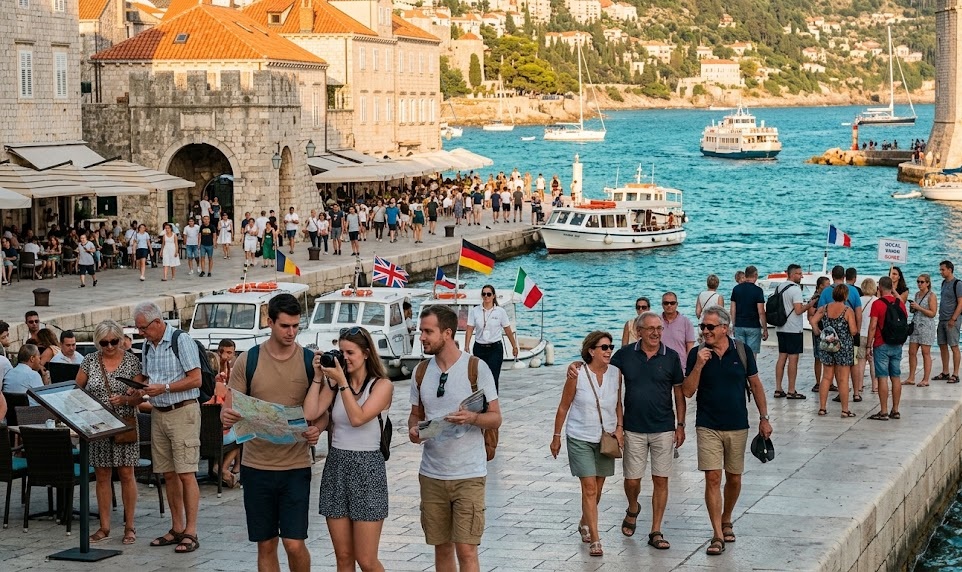
The numbers are striking: over 1.1 million arrivals in Q1 2026, with Dubrovnik seeing heavy crowds even before summer begins.
Dubrovnik’s iconic walled city along the Adriatic Sea is seeing heavy tourist crowds before summer even begins
Reshaping Europe’s Travel Map
Croatia is diverting travelers from traditional Mediterranean destinations:
- Italy and Spain are seeing shoulder-season traffic shift to Croatia for lower prices, fewer crowds, and more authentic experiences
- Dubrovnik and Split are competing directly with Venice and Barcelona for cruise ship passengers, with authorities now restricting cruise ship numbers
- Istria region attracts day-trippers who might have previously visited the French Riviera at lower costs
Economic Impact and Sustainability Challenges
Tourism accounts for 20% of Croatia’s GDP, creating thousands of jobs while driving up housing prices in popular areas like Dubrovnik and Split. However, rapid growth has sparked concerns:
- Environmentalists worry about mass tourism’s impact on Croatia’s 1,880 km of coastline, 600+ islands, and 8 national parks
- Dubrovnik is restricting cruise ships while the government limits short-term rentals to combat overtourism
- Raised fuel prices are affecting air traffic, as Croatia relies almost completely on air travel
Key Points
The Peristyle of Diocletian’s Palace in Split, Croatia, a UNESCO World Heritage site, with its colonnaded courtyard and the Prothyron.
- Croatia welcomed 3 million overnight stays in Q1 2026, a 9% increase in arrivals and 8% rise in overnight stays versus 2025
- Schengen and Euro adoption removed barriers for 80% of tourists from Schengen and 60% from eurozone countries
- Tourism accounts for 20% of GDP, with the boom reshaping Europe’s travel map by diverting travelers from Venice and Barcelona
The Peristyle of Diocletian’s Palace in Split, a UNESCO World Heritage Site, is seeing increased tourist footfall
Bottom Line: Croatia’s tourism boom is rewriting Europe’s travel map, transforming the country from a “summer alternative” into a primary Mediterranean destination competing directly with Italy and Spain. With Schengen and Euro membership removing friction, 3 million overnight stays in Q1, and 20% GDP contribution, Croatia is no longer the hidden gem—it’s the new European travel powerhouse, even as it grapples with overtourism’s environmental and social costs


More Stories
Spire Hospitality Launches AI-Driven Strategic Asset Performance Division for Hotel Owners
HVS: U.S. Hotel RevPAR Up Over 10% Mid-September as Nearly 1,000 Hotels Sold in H1 2026
Hilton, Accor, Wyndham CEOs Split on AI Jobs as Voice Agents Lift Hotel Bookings