










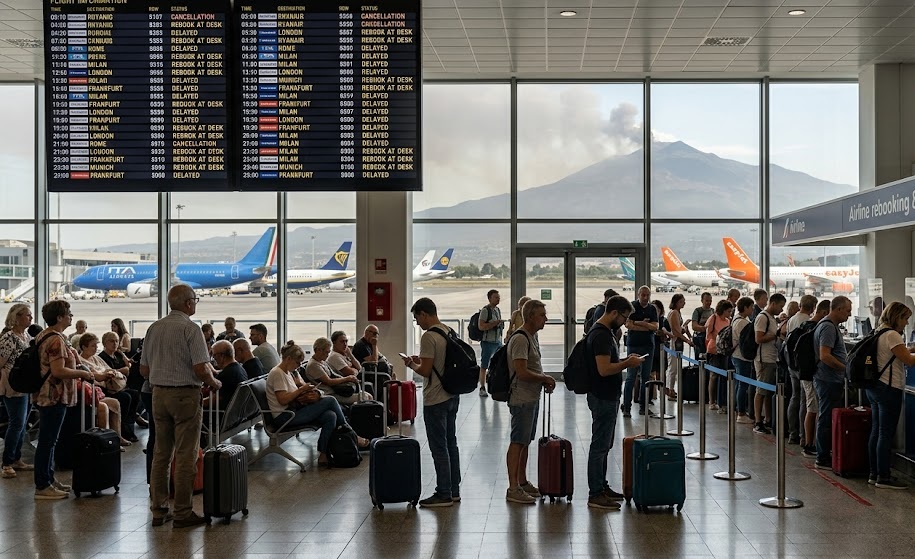
European air travel is facing another wave of disruption, with airports in Italy and other parts of the continent experiencing cancellations, delays and operational restrictions. Rome and Catania are among the destinations attracting particular attention, as passengers deal with a combination of airport disruption, industrial action and severe volcanic activity affecting flight operations.
The situation is especially serious in Catania, Sicily, where flights were suspended on September 14 after volcanic ash from Mount Etna affected the airport’s operating environment. The disruption adds another difficult chapter to a summer in which Etna’s repeated activity has repeatedly interfered with flights to and from eastern Sicily.
Catania Airport Hit by Mount Etna Ash
Catania Fontanarossa Airport was forced to suspend flight operations on Monday as ash from Mount Etna created unsafe conditions for aviation.
Arrivals were initially suspended until 4 p.m. local time, but the airport operator later extended the restrictions to include departures, with operations suspended until 10 p.m. The decision affected one of Italy’s busiest airports and immediately created problems for passengers travelling between Sicily and major European cities.
The disruption is particularly significant because Catania is a major gateway for eastern Sicily. The airport handles connections to destinations across Italy and Europe, meaning a closure can quickly affect holidaymakers, business travellers and passengers using connecting flights.
Multiple Catania Flights Cancelled
Live airport information shows the impact of the restrictions clearly. On September 14, flights operated by ITA Airways, Ryanair, easyJet, Wizz Air Malta, Transavia France and other carriers were showing cancellations or diversions at Catania. Services connecting the airport with Rome, Milan, Genoa, Turin, Brussels, Paris and Berlin were among those affected.
Some flights continued operating when conditions permitted, while others were delayed or diverted. This means passengers should not assume that every flight to or from Catania has been grounded for the entire day.
The airport’s live status can change quickly as volcanic conditions, wind direction and aviation safety assessments evolve.
Rome Also Faces Flight Disruption
Rome Fiumicino Airport has experienced cancellations during September, although its disruption has been substantially different from the volcanic situation in Catania.
Available September data recorded 17 cancellations at Rome Fiumicino, including 10 departures and seven arrivals, with British Airways accounting for eight of the recorded cancellations. The most affected route was between Rome and London Heathrow.
Recent disruption around Rome has also been connected with industrial action affecting airport operations. This adds another layer of uncertainty for passengers travelling through Italy’s principal international gateway.
Italy’s Airport Network Faces Multiple Pressures
The problems in Rome and Catania are occurring against a wider backdrop of disruption across Italy’s aviation network.
Earlier in September, industrial action affected airports including Olbia and Cagliari, while further airport strikes were scheduled to affect Rome, Pisa and Florence. These events can create cancellations even when weather and airport infrastructure are operating normally.
For airlines, the effects can continue after a strike ends. Aircraft and crews may be out of position, replacement flights can become difficult to arrange and passengers from cancelled services can fill later departures.
Etna Creates A Different Kind of Aviation Risk
The Catania situation is particularly challenging because volcanic ash cannot be treated like ordinary bad weather.
Ash particles can damage aircraft engines and affect visibility, meaning aviation authorities must carefully assess conditions before allowing normal operations to resume. Even when an eruption itself does not appear dramatic from the ground, the movement of an ash cloud can determine whether aircraft can safely operate.
Mount Etna is Europe’s highest and most active volcano, and its frequent activity makes Catania unusually vulnerable to sudden aviation disruption. Reuters reported that ash emissions had been particularly intense during the summer of 2026, affecting thousands of travellers.
Diversions Offer An Alternative — But Not A Simple One
When Catania cannot operate normally, airlines may divert flights to alternative airports, including Palermo or other airports elsewhere in Sicily and southern Italy.
However, diversion does not necessarily mean passengers can continue their journeys immediately. Alternative airports may already be busy, while ground transportation from a different airport can add several hours to a trip.
For tourists with hotel reservations, rental cars, ferries or onward connections, a diversion can therefore create a chain of additional problems.
Connecting Passengers Face The Biggest Risk
Passengers travelling on multi-flight itineraries are particularly vulnerable to the latest disruption.
A cancelled Catania-Rome service, for example, could prevent a passenger from reaching an onward international flight from Rome. Similarly, travellers arriving in Catania after a long diversion may find that their connecting transport, hotel check-in or ferry departure is no longer practical.
Passengers should therefore contact their airline as soon as a flight is cancelled rather than waiting until they reach the airport.
European Travel Remains Busy
The latest disruption comes as European aviation continues to operate at high volumes. Airports remain heavily used by holidaymakers, business travellers and passengers returning home after the summer season.
That leaves relatively little spare capacity when an airport suddenly closes or a large number of flights are cancelled.
A disruption affecting one airport can also spread to other cities because aircraft and crews operate multiple flights during the same day. A late aircraft arriving in Rome, for example, can subsequently depart for another European destination behind schedule.
What Travellers Should Do
Passengers travelling through Catania, Rome or other Italian airports should check their flight status directly with the airline before travelling to the airport.
Those affected by cancellations should ask about rebooking, refunds and alternative routing, while passengers with onward connections should make sure their entire itinerary is protected.
Travellers heading to Sicily should also monitor official airport and aviation updates because volcanic conditions can change rapidly.
For passengers already in Catania, allowing extra time for ground transportation and checking whether their flight has been diverted can prevent additional problems during the disruption.
The Bigger Picture For European Aviation
The latest situation demonstrates how different types of disruption can hit European aviation at the same time.
Volcanic ash in Sicily, industrial action in Italy and broader operational pressures elsewhere in Europe all have the potential to affect passenger journeys. While each event may have a different cause, the consequences can be similar: cancellations, delayed departures, missed connections and longer journeys.
For travellers, flexibility is becoming increasingly valuable when flying through heavily used European hubs.
Key Takeaways
- Catania Airport suspended flights on September 14 after volcanic ash from Mount Etna affected aviation operations.
- The Catania suspension was extended to cover both arrivals and departures until 10 p.m. local time.
- Live airport data showed cancellations affecting services operated by Ryanair, ITA Airways, easyJet, Wizz Air Malta and other airlines.
- Routes connecting Catania with Rome, Milan, Paris, Brussels, Berlin and other European cities have been affected.
- Rome Fiumicino has also recorded cancellations during September, with 17 logged so far in available airport data.
- Industrial action at several Italian airports has added another source of disruption to the country’s aviation network.
- Mount Etna’s volcanic ash is a major aviation hazard because ash can threaten aircraft engines and visibility.
- Passengers with connecting flights face a higher risk of missed onward services when cancellations or diversions occur.
- Travellers should check their individual flight status, contact their airline promptly after cancellations and allow additional time for alternative transport.
Bottom Line
Flights across parts of Europe are facing renewed disruption, with Rome and Catania among the destinations under pressure. Catania’s situation is particularly serious because Mount Etna’s volcanic ash has forced the airport to suspend both arrivals and departures, while Rome and other Italian airports have experienced separate cancellation and strike-related problems. For travellers, the safest approach is to monitor airline updates closely, allow extra time and remain prepared for rerouting, delays or cancellations when flying through affected European airports.



More Stories
Belgians Could Get Faster US Airport Entry By End Of 2026
FAA Fines Unruly Airline Passengers $1.5 Million in 2026
Asia Travel Disrupted by 3,657 Delays