










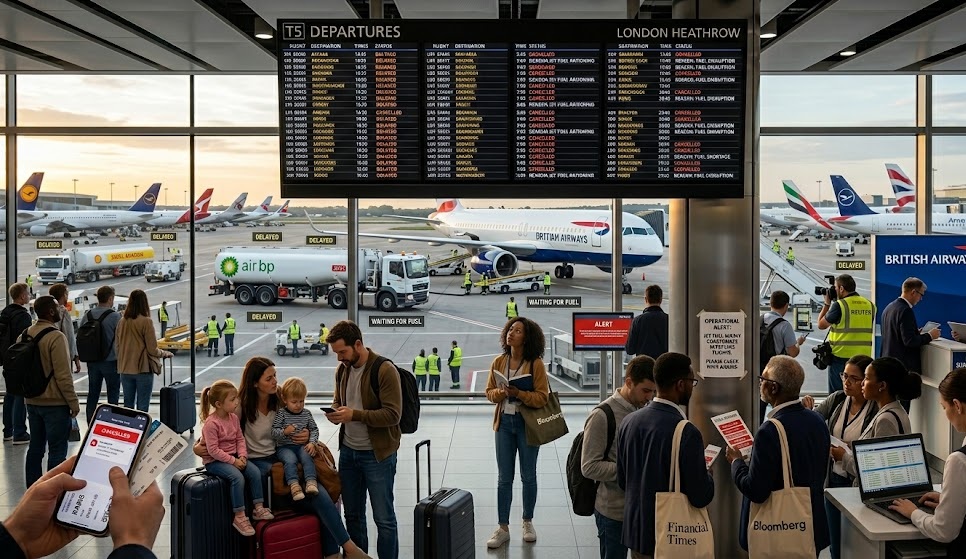
The United Kingdom has become the epicenter of a global aviation crisis as jet fuel shortages and energy disruptions slam hubs from London Heathrow and Gatwick to Beijing, Berlin, Rome, and Paris, turning summer travel into a high-stakes gamble. Jet fuel prices have more than doubled since the Iran conflict over the Strait of Hormuz began, forcing airlines to cancel flights, slash schedules, and consolidate passengers onto fewer aircraft just as the busy summer season kicks off.
The Perfect Storm for UK Travelers
UK airports are in the thick of the chaos. In just one week, over 40 flights were axed at Heathrow, Gatwick, and Manchester, with carriers like British Airways, Air Canada, JetBlue, and WestJet pulling the plug on routes to York, Mumbai, Paris, and Dublin. May 2026 alone recorded 296 cancellations from UK airports—a sharp spike from just 120 a few days earlier.
The UK’s vulnerability is stark: it depends on imports for 65% of its jet fuel, mostly from the Middle East. When fuel prices more than double overnight, airlines have no choice but to make tough calls—cutting flights and shrinking capacity to survive.
Government Response and Passenger Impact
Transport Secretary Heidi Alexander assures summer holidays won’t be wrecked, citing extra fuel sourced from the U.S. and increased UK refinery production. A new contingency plan could allow airlines to cancel flights weeks in advance without losing airport slots, reducing last-minute gate chaos but guaranteeing fewer flights overall.
The wallet hit is real: with fewer seats available, airfares are rising 15–30% for summer flights. Business travelers face longer layovers and reduced flight frequencies, while some are turning to rail for short-haul European trips like London–Paris and London–Amsterdam.
Airlines are now under intense pressure to accelerate sustainability efforts, investing in fuel-efficient aircraft like the Boeing 787 and Airbus A350, and exploring sustainable aviation fuel (SAF) to offset emissions. However, with jet fuel prices at historic highs, many carriers struggle to justify the capital investment needed for fleet modernization. The UK government is under pressure to offer tax incentives and SAF subsidies, similar to those in the U.S. and EU, to help airlines transition without passing all costs onto passengers.
The Long-Term Outlook
If the fuel crisis drags on through the summer, the UK aviation sector could face structural changes: reduced flight frequencies, route consolidation, and even the potential for some smaller regional airports to face financial pressure or temporary closures. Airlines may also rethink their hub-and-spoke models, shifting more traffic to point-to-point routes that require fewer fuel-intensive connections.
For travelers, summer 2026 could be one of the most challenging travel seasons in recent history, with higher fares, fewer flight options, and the need for greater flexibility in travel plans. The advice is clear: book early, monitor flight status closely, and consider travel insurance that covers cancellations and delays due to fuel shortages or energy disruptions.
Key Points
- The UK is joining China, Germany, Italy, France, and South Africa in a global aviation energy crisis, with 296 cancellations from UK airports in May 2026.
- Jet fuel prices have more than doubled, and the UK relies on 65% imported jet fuel, making it highly vulnerable to Middle East supply disruptions.
- Airlines are consolidating passengers and cutting summer schedules, while the government drafts plans for advance cancellations without losing airport slots.
- Airfares are rising 15–30%, with increased reliance on rail for short-haul European trips.
Bottom Line: Summer travel in the UK just got riskier. With jet fuel shortages hitting airports at the start of the season, the country is at the heart of a global energy squeeze that is forcing airlines to cut flights and raise



More Stories
GIC Acquires 16 Marriott-Operated Hotels in Japan for About $800 Million Amid Tourism Boom
Hilton, Accor, Wyndham CEOs Split on AI Jobs as Voice Agents Lift Hotel Bookings
Choice Hotels to Acquire Harvest Hosts for ~$130M, Expanding Into RV and Outdoor Travel