









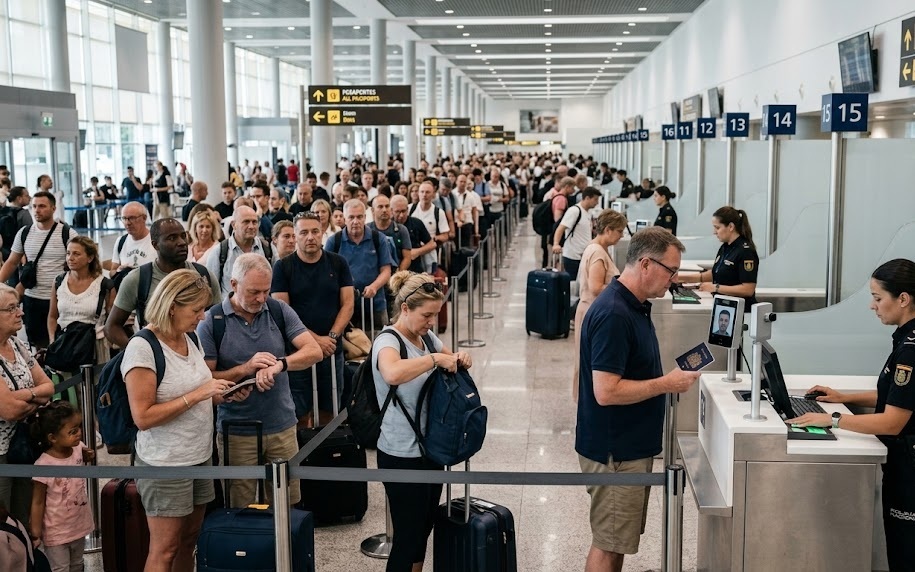
UK travellers heading to Europe are facing a fresh risk of longer border queues as the European Union ends temporary flexibility measures for its new Entry/Exit System (EES) from September 6, 2026. The change means border authorities will have less ability to temporarily suspend biometric registration when passenger queues become excessive, raising concerns about renewed congestion at busy European airports and land crossings.
The development comes after a summer in which airlines, airports and travel organisations repeatedly warned that the new biometric system was creating delays at some of Europe’s busiest gateways. Industry groups are now urging European authorities to maintain the emergency “safety valve” until the system is consistently equipped with sufficient technology, infrastructure and staffing.
EES Flexibility Ends After September 6
The Entry/Exit System, or EES, became fully operational across external Schengen borders on April 10, 2026. It replaces traditional passport stamping for eligible non-EU short-stay travellers and digitally records passport information, entry and exit dates, facial images and fingerprints.
During the transition, European countries were allowed to temporarily suspend biometric collection at individual border crossing points when queues became unmanageable. That flexibility has been particularly important during busy holiday periods.
From September 6, however, that temporary suspension mechanism is due to expire. As a result, airports and border posts will have fewer options to ease congestion by temporarily reverting to less demanding procedures.
Why British Travellers Are Particularly Affected
British passport holders are among the travellers affected because the UK is outside the EU and Schengen Area. UK citizens visiting participating Schengen countries for short stays are treated as non-EU nationals under EES rules.
On their first EES registration, travellers provide passport information together with a facial image and fingerprints. On later crossings, their biometric information can be checked against the record already held in the system.
The system applies across the 29 European countries participating in EES, including Schengen countries such as France, Germany, Spain, Italy, Greece, the Netherlands, Switzerland and Norway. Ireland and Cyprus are outside the EES system.
Border Queues Have Already Increased
The concern about September is not simply theoretical. European airports have already experienced significant increases in waiting times since biometric registration became part of the border process.
According to data reported by Euronews, average waiting times at Frankfurt Airport reached 120 minutes in July, compared with 60 minutes a year earlier. At Munich, waits rose to as much as 60 minutes from 31 minutes, while Amsterdam’s maximum waiting time increased from 80 to 120 minutes.
The International Air Transport Association has also said that standard passport checks that previously took roughly 20 to 25 seconds can take around 90 seconds under the new process. When thousands of passengers arrive close together, even a relatively small increase in processing time can create substantial queues.
Missed Connections Become a Bigger Concern
Longer border processing can have consequences beyond simply waiting longer at passport control.
Passengers travelling through major European hubs may have to clear border controls before continuing to another flight, particularly when travelling between the UK and the Schengen Area. A lengthy queue can therefore turn a seemingly comfortable connection into a missed flight.
The Financial Times reported that missed connections doubled during the summer as EES-related queues affected European airports, with some airlines reporting even larger increases at particular locations. Technical problems, insufficient staffing and congestion contributed to the disruption.
For British travellers using multi-leg itineraries, this makes connection times an increasingly important consideration.
Airports and Airlines Want the Flexibility Extended
The aviation industry is not calling for the EES to be abandoned. Instead, airlines and travel organisations are asking the EU to keep the emergency flexibility available while airports complete the transition.
IATA has urged the European Commission to extend the possibility of partial suspension until the end of the winter season, arguing that reliable technology, fully deployed kiosks, automated border controls and adequate staffing are needed before the safety mechanism is removed.
UK travel industry organisation ABTA has also called for the measures to remain available beyond September, warning that the system still needs further work to operate consistently across participating countries.
The European Commission, meanwhile, has said that EES has broadly worked well during the summer and that authorities are continuing to work with member states where adjustments are needed at particular border crossings.
What UK Travellers Should Expect
The end of the flexibility measures does not mean that every British traveller will face hours-long queues. Conditions will vary by airport, border crossing, passenger volume, staffing and the availability of automated equipment.
However, travellers should expect the possibility of longer processing times, particularly during peak periods.
UK passengers travelling to Europe should therefore:
- Allow significantly more time for passport control.
- Avoid booking extremely tight flight connections.
- Expect biometric registration or verification when entering participating Schengen countries.
- Check their airline and airport guidance before departure.
- Allow additional time at Dover, Eurotunnel and Eurostar, where border formalities take place before leaving the UK.
The UK government has previously provided £10.5 million to support infrastructure at the major juxtaposed border points used by British travellers, including Dover, Folkestone and St Pancras.
Not Every Traveller Is Subject to EES
There are also important exemptions. EU citizens and nationals of Iceland, Liechtenstein, Norway and Switzerland are not registered in EES.
Certain non-EU travellers are also exempt, including people holding qualifying long-stay visas or residence permits, as well as some family members of EU, Icelandic, Liechtenstein, Norwegian or Swiss citizens who hold the appropriate residence documentation.
British citizens travelling with qualifying EU residence rights or using an EU passport can therefore have different requirements from ordinary UK passport holders travelling as short-stay visitors.
EES Is Not the Same as ETIAS
British travellers should also distinguish EES from ETIAS, the planned European travel authorisation.
EES is a border registration and biometric system. It is already fully operational. ETIAS, by contrast, is a separate electronic travel authorisation for visa-exempt travellers and is being introduced on a different timetable.
Confusion between the two systems has contributed to uncertainty among travellers, but the September 6 change specifically concerns the EES border-control flexibility, not the introduction of ETIAS.
Europe Faces a Critical Test This Autumn
The end of the temporary flexibility comes at a crucial moment for European travel. The busiest summer period is ending, but airports will continue handling substantial international passenger volumes through autumn and winter.
The key question is whether the technology and staffing improvements made during the EES rollout will be sufficient to prevent the queues experienced earlier in 2026.
For UK travellers, the practical message is straightforward: Europe remains open for travel, but border processing may take longer and should be treated as part of the journey rather than an afterthought.
Key Takeaways
- EES flexibility measures expire on September 6, 2026, leaving European border authorities with fewer options to suspend biometric collection when queues become excessive.
- UK passport holders are subject to EES when making short stays across participating Schengen borders and may need to provide fingerprints and a facial image.
- Frankfurt, Munich and Amsterdam have already recorded significantly longer border waits during the EES rollout.
- Airlines reported that missed flight connections increased sharply during the summer as border queues disrupted passenger journeys.
- IATA and UK travel organisations are calling for the emergency flexibility to continue, particularly through the winter season.
- Travellers should allow extra time at airports and land borders and avoid unnecessarily tight connections.
- EES is already operational, while ETIAS is a separate future travel-authorisation system.
Bottom Line
The end of EES flexibility on September 6 marks an important new phase for travel between the UK and continental Europe. The biometric system itself is not being introduced on this date—it is already operational—but European border authorities will have less ability to pause biometric procedures when queues become severe. For British travellers, the safest approach is to build extra time into airport journeys, avoid tight connections and prepare for longer border processing, particularly at major European hubs during busy travel periods.



More Stories
GIC Acquires 16 Marriott-Operated Hotels in Japan for About $800 Million Amid Tourism Boom
Choice Hotels to Acquire Harvest Hosts for ~$130M, Expanding Into RV and Outdoor Travel
Hyatt’s Luxury Push Across the Americas Centers on Mexico Park Hyatt Trio and Unbound Growth