










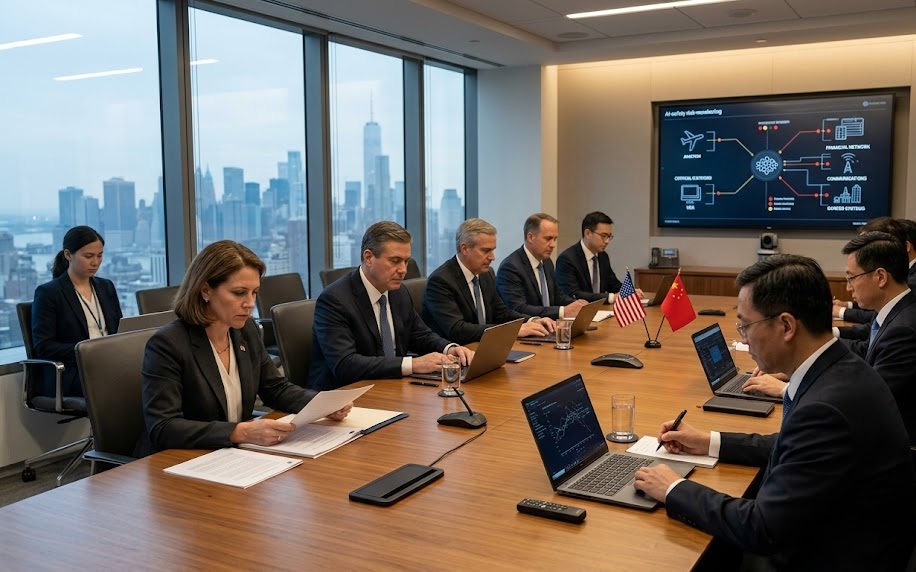
The United States and China are opening a new channel for artificial intelligence safety discussions, creating an unusual area of dialogue between two countries competing intensely for technological leadership. The talks are focused on managing shared AI-related risks, including serious incidents that could threaten national security, while broader disagreements over technology, trade and strategic competition remain unresolved.
The development comes just days before Chinese President Xi Jinping’s September 23–25 state visit to the United States and a planned meeting with U.S. President Donald Trump on September 24. The two governments are expected to discuss AI alongside wider economic and geopolitical issues.
Washington Proposes AI Incident Notification System
The most concrete proposal emerging from the latest discussions is a potential AI safety notification mechanism.
U.S. Treasury Secretary Scott Bessent said after talks with Chinese Vice Premier He Lifeng in New York that Washington had proposed establishing a mechanism through which the two countries could notify each other about AI incidents serious enough to raise national-security concerns. The proposal is intended to create communication around shared threats rather than eliminate the wider technological competition between the countries.
Bessent said greater transparency between the world’s two leading AI powers could be important for managing risks associated with increasingly capable systems. Reuters subsequently reported that the two sides had agreed to formalize an AI dialogue and were considering an incident line for communicating about AI safety emergencies.
AI Competition And Safety Concerns Move Together
The significance of the talks comes from the unusual combination of competition and cooperation.
The United States and China are competing over advanced AI models, computing infrastructure and semiconductor technology, while each government is also increasingly concerned about how powerful AI systems could be misused or become difficult to control.
Reported areas of concern include AI-enabled cyberattacks, malicious autonomous agents, biological misuse, loss of human control and attacks against critical infrastructure. Transportation is among the infrastructure sectors identified in discussions about potential AI-related risks.
That does not mean an AI-related disruption to commercial travel is currently occurring. Rather, transportation and other essential systems are being considered as potential areas where advanced AI could create security risks in the future.
Why Travel Is Part Of The Broader Security Discussion
The connection between AI safety and travel comes largely through critical infrastructure.
Modern aviation depends on interconnected digital systems for air-traffic management, airport operations, aircraft maintenance, passenger processing, communications and logistics. Rail networks, ports and other transportation systems similarly depend on software and network infrastructure.
As AI becomes more capable and autonomous, governments are examining whether malicious actors could use it to attack or manipulate such systems. U.S. and Chinese security experts have therefore discussed safeguards around consequential cyber operations and maintaining human control over high-impact actions.
For travellers, the immediate implication is not a new border rule or flight restriction. The longer-term issue is resilience: whether transportation infrastructure can remain secure as AI becomes increasingly integrated into critical systems.
Aviation Is Already Exploring AI At A Rapid Pace
The travel industry is not waiting for the geopolitical debate to settle before adopting AI.
Airlines, airports and aviation authorities are exploring artificial intelligence for air-traffic management, predictive maintenance, passenger services, operational decision-making and security.
Recent discussions at the China Air Transport Association conference, for example, highlighted AI’s potential to transform civil aviation while emphasizing the need for governance and international cooperation to ensure that the technology is deployed safely.
This creates a parallel development: AI could make travel systems more efficient while simultaneously creating new cybersecurity and governance challenges.
A Potential Channel For Crisis Communication
One of the most important elements of the emerging U.S.-China dialogue is the possibility of having a direct communication channel when an AI incident occurs.
Experts involved in related discussions have proposed concepts ranging from an AI hotline to clearly defined thresholds for incidents that could trigger urgent communication between Washington and Beijing. Reuters reported that security experts have also recommended human-control requirements for consequential cyberattacks and safeguards around nuclear systems.
Such mechanisms would not prevent every incident. Their purpose would be to reduce the risk that an AI-driven event is misunderstood as deliberate action by the other government, particularly when automated systems could act at high speed.
The Trump-Xi Meeting Raises The Stakes
The timing of the discussions is significant because Xi Jinping is scheduled to visit the United States from September 23 to 25, with AI expected to form part of the broader agenda.
The visit follows the New York discussions between Bessent and He Lifeng, where AI, trade and other economic issues were addressed. Chinese officials have confirmed the visit and described it as an opportunity for deeper exchanges on China-U.S. relations and wider global issues.
Whether the leaders produce a detailed AI agreement remains uncertain. The current mechanism is better understood as the beginning of a formal dialogue rather than a comprehensive international AI safety treaty.
Export Controls Remain A Separate Issue
The new AI safety channel does not eliminate the technological rivalry between Washington and Beijing.
The United States continues to restrict China’s access to certain advanced AI chips and semiconductor technologies, while Chinese companies are developing increasingly capable domestic alternatives and frontier AI models.
Reuters reported that U.S. export controls on advanced AI technology were not discussed during the latest Bessent-He talks. This illustrates the distinction between cooperation on specific safety risks and the broader competition over AI capabilities.
The two countries can therefore discuss how to respond to an AI emergency while continuing to disagree over technology access and strategic advantage.
Travel Security Could Become A Bigger AI Issue
For the travel industry, the most important question may eventually be how AI is integrated into infrastructure rather than which country develops the most advanced model.
Airports increasingly rely on automated systems, biometric processing, digital identity, predictive analytics and connected operational networks. Airlines use software and AI-based systems to manage fleets, schedules, customer service and maintenance.
As adoption expands, governments and aviation regulators will need to determine which AI systems require human oversight, how incidents should be reported and how critical infrastructure can continue operating if an AI system fails or is compromised.
These questions are still developing and should not be interpreted as evidence that ordinary travellers currently face a new AI-related travel threat.
Europe And Other Regions Will Be Watching
The U.S.-China dialogue could eventually have consequences beyond the two countries.
If Washington and Beijing develop practical procedures for reporting major AI incidents, other governments may consider similar mechanisms. International aviation, shipping, telecommunications and financial systems could potentially benefit from clearer protocols for dealing with AI-related disruptions.
At the same time, differences between national AI regulations and technology policies could make global coordination difficult.
The outcome of the September discussions may therefore influence not only the U.S.-China relationship but also the broader debate over international AI governance and critical-infrastructure security.
A New Kind Of Global Technology Diplomacy
The emerging AI dialogue represents a notable shift in international technology diplomacy. The United States and China remain strategic competitors, yet both have identified risks that could cross national borders and affect shared systems.
For the travel sector, the development is worth watching because aviation, transportation and tourism increasingly depend on digital infrastructure.
The immediate story is not about cancelled flights or new travel restrictions. It is about whether governments can establish safeguards before AI becomes even more deeply embedded in the systems that allow millions of people to travel every day.
Key Takeaways
- The United States has proposed an AI incident notification mechanism with China for serious events that could raise national-security concerns.
- Washington and Beijing are establishing a more formal AI dialogue, including discussions about communications protocols for AI safety incidents.
- Xi Jinping is scheduled to visit the United States from September 23–25, 2026, with a Trump-Xi meeting planned for September 24.
- AI safety discussions include risks involving cyberattacks, autonomous agents, biological misuse, loss of control and critical infrastructure.
- Transportation and aviation could become important parts of future AI-security planning because their operations increasingly depend on connected digital systems.
- The latest discussions do not represent a new AI-related travel restriction or evidence of an immediate threat to ordinary travellers.
- U.S. restrictions on advanced AI chips remain a separate issue, showing that AI safety cooperation does not end the wider technology competition.
- Security experts have proposed measures including human control over consequential cyber operations and direct communication channels for serious AI incidents.
- The emerging U.S.-China framework could eventually influence broader international approaches to AI governance, cybersecurity and critical infrastructure protection.
Bottom Line
The United States and China are opening a limited but significant new channel on AI safety at a time of intense technological competition. The proposed incident-notification mechanism is designed to improve communication around serious AI risks rather than resolve the countries’ wider disagreements. For the travel industry, the significance lies in the growing dependence of aviation, airports and transportation networks on AI and digital infrastructure.



More Stories
Spire Hospitality Launches AI-Driven Strategic Asset Performance Division for Hotel Owners
Hilton, Accor, Wyndham CEOs Split on AI Jobs as Voice Agents Lift Hotel Bookings
HyperGuest Lands $25M From Apax as Hotel Distribution Bets on Direct Connectivity and AI