









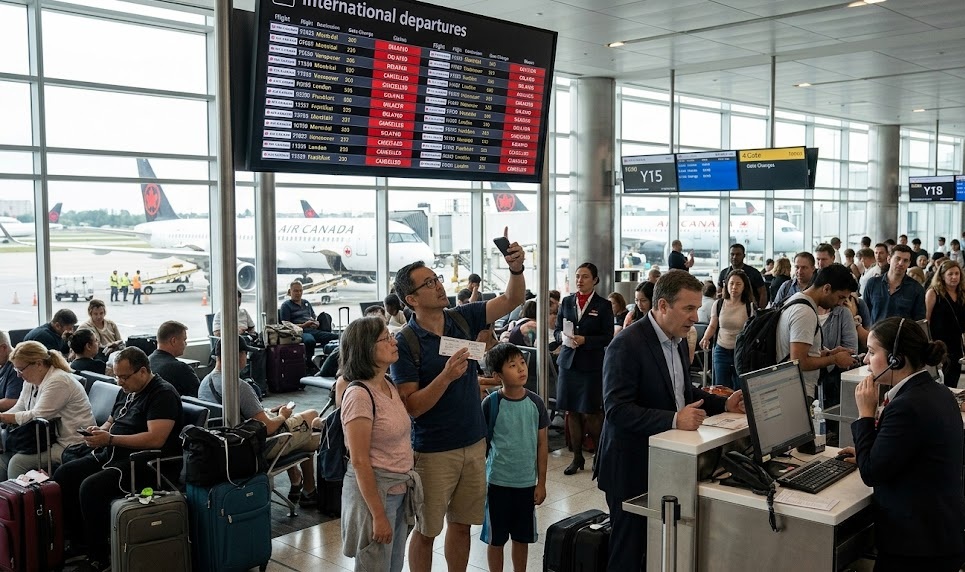
Canada’s air travel network is under severe stress today as 43 Air Canada flights are delayed and 9 are canceled, leaving thousands of passengers stranded and disrupting both domestic and international connections across the country. The disruptions are hitting Toronto Pearson, Montreal‑Trudeau, Vancouver International, Calgary International, Ottawa Macdonald‑Cartier, Halifax Stanfield, and other major hubs, with ripple effects spreading through Air Canada’s extensive domestic, U.S., and transatlantic networks.
Where the chaos is worst
Toronto Pearson International Airport, Canada’s busiest hub, is bearing the brunt of the disruptions, with 43 delayed flights reported from Air Canada alone—the highest concentration of any airport in the country. The airport’s massive scale (46 airlines, 147 destinations) means delays here quickly cascade into missed connections for passengers on flights to Europe, Asia, the U.S., and across Canada.
Montreal‑Trudeau and Vancouver International are also heavily impacted, with Air Canada reporting 24 delays and 3 cancellations in Montreal and 43 delays and 2 cancellations in Vancouver. Calgary International Airport has seen 23 delays and 3 cancellations, while Ottawa and Halifax are experiencing knock‑on effects from the hub‑airport chaos, with multiple Air Canada flights pushed back or held on the tarmac beyond scheduled departure times.
What travelers are facing
For passengers, the day has turned into a rolling re‑booking nightmare:
- Many are dealing with multi‑hour delays and last‑minute cancellations, especially on peak business‑hour and evening‑departure slots that feed into international connections.
- Air Canada’s flight status apps and websites show dense clusters of “delayed” and “cancelled” tags, forcing travelers to re‑route through alternative airports or even switch to ground transport for urgent trips.
- Customer‑service channels are strained, with hold‑times stretching and agents prioritizing safety‑critical and crew‑related rerouting over regular‑passenger rebooking, further inflaming frustration among leisure travelers and small‑group tour groups.
Why this is happening in 2026 Canada
The scale of today’s disruption reflects broader 2026 pressures on Canada’s aviation system: high demand, tight‑turn‑time schedules, and ongoing crew‑and‑maintenance pinch points are making the network fragile, so even moderate weather events or technical hiccups can cascade into dozens of delayed or cancelled flights. At the same time, record‑level tourism and business travel mean airports are operating near capacity, so any blockage in air‑traffic‑flow or at ground‑level handling quickly ripples through the whole network, especially in Toronto, Vancouver, and Montreal, which act as primary Canadian gateways.
Key Points
- 43 Air Canada flights are delayed and 9 are canceled today, with disruptions concentrated at Toronto, Montreal, Vancouver, Calgary, Ottawa, and Halifax.
- Toronto Pearson alone accounts for 43 Air Canada delays, the highest of any airport, while Montreal (24 delays, 3 cancellations) and Vancouver (43 delays, 2 cancellations) also face significant pressure.
- The chaos reflects a 2026‑style fragile‑but‑high‑demand air‑travel environment, where operational hiccups fast translate into mass cancellations and delays, especially at congested gateways.
Bottom Line: With 43 delayed flights and 9 cut today, Canada’s major airports are living out the downside of a record‑busy travel year—where a single day of operational stress can turn into a national‑scale schedule‑meltdown, testing the resilience of Air Canada’s network and the patience of every passenger on the move.



More Stories
Belgians Could Get Faster US Airport Entry By End Of 2026
Flights Cancelled Across Europe As Rome, Catania And More Face Disruption
FAA Fines Unruly Airline Passengers $1.5 Million in 2026