










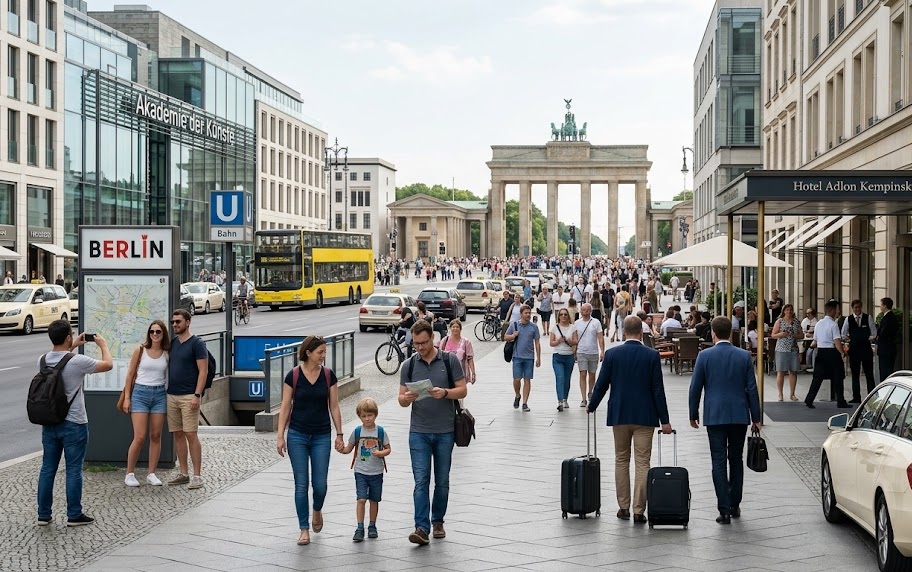
Berlin is maintaining its position as one of Europe’s leading city destinations in 2026, with strong international demand, major events, and a diverse tourism offering helping the German capital remain resilient despite a challenging travel environment. The city recorded around 29.4 million overnight stays from 12.4 million guests in 2025, demonstrating that Berlin continues to attract substantial visitor volumes from Germany and overseas.
International travelers remain a major part of Berlin’s tourism economy, accounting for 41% of overnight stays in 2025. The United States, United Kingdom, and Netherlands were the leading international source markets, while visitor numbers from China and India also showed strong growth, giving Berlin additional opportunities to diversify its international tourism base.
International Markets Keep Berlin Competitive
The United States was Berlin’s largest foreign market in 2025, generating around 1.28 million overnight stays, closely followed by the United Kingdom with approximately 1.27 million. Other important European markets included the Netherlands, Spain, and Italy, helping maintain a broad international visitor base.
At the same time, emerging markets are becoming increasingly important. Overnight stays from China increased by 14.4%, while India recorded a 10% rise in 2025. Growth from these markets could become particularly valuable as Berlin looks to strengthen long-haul tourism and reduce reliance on its traditional European markets.
2026 Begins With Mixed but Stable Demand
The first quarter of 2026 showed a more mixed picture. Berlin welcomed around 2.6 million visitors and recorded 5.9 million overnight stays between January and March, with total visitor numbers remaining broadly stable compared with the previous year. Domestic demand provided important support, with German visitor numbers increasing by 2.4%.
International tourism was softer during the opening quarter, with foreign arrivals down 4.3% and international overnight stays down 6.3% year on year. However, the overall figures suggest that Berlin continues to maintain a substantial tourism base while adapting to changing international travel conditions.
Major Events Strengthen Berlin’s 2026 Outlook
Berlin is expecting additional momentum from major trade fairs, conferences, cultural events, and international attractions throughout 2026. Events such as ILA and InnoTrans are expected to support business travel, while Berlin’s cultural calendar continues attracting leisure visitors.
The city is also investing in its tourism infrastructure and hotel sector. Major hotel modernisations, new properties, cultural attractions, and future developments are expected to strengthen Berlin’s ability to accommodate international visitors and compete with other major European capitals.
Tourism Remains Important to Berlin’s Economy
Tourism contributes far beyond hotels and sightseeing businesses. Berlin’s visitor economy generated approximately €15.1 billion in tourist consumption and €8.4 billion in gross value added, while around 224,800 people depend directly or indirectly on tourism-related activity.
This makes maintaining a healthy tourism sector important for restaurants, cultural venues, transport operators, retailers, event companies, and businesses across Berlin’s neighborhoods. The city is increasingly focused on spreading visitor activity beyond traditional attractions so that more communities benefit from international tourism.
Berlin Focuses on Sustainable Tourism Growth
Rather than simply pursuing higher visitor numbers, Berlin is increasingly emphasizing sustainable and city-friendly tourism. Tourism authorities are promoting neighborhood attractions, digital visitor services, environmentally responsible travel, and events that can distribute visitor flows more evenly across the city.
This approach could help Berlin manage tourism growth while protecting residents’ quality of life. By combining international marketing with sustainable destination management, the capital aims to remain attractive to visitors without allowing tourism pressure to become concentrated in a small number of areas.
Key Takeaways
- Berlin recorded 29.4 million overnight stays from 12.4 million visitors in 2025, maintaining its position as a leading European city destination.
- International visitors accounted for 41% of overnight stays, with the United States, United Kingdom, and Netherlands among the strongest source markets.
- China and India are emerging as important growth markets, with overnight stays rising by 14.4% and 10% respectively in 2025.
- Berlin welcomed around 2.6 million visitors in the first quarter of 2026, keeping overall demand broadly stable despite softer international figures.
- Major trade fairs, conferences, cultural events, and new tourism developments are expected to support Berlin’s travel economy throughout 2026.
- Tourism contributes approximately €15.1 billion in visitor spending and €8.4 billion in gross value added, supporting around 224,800 tourism-related jobs.
- Berlin is increasingly prioritising sustainable tourism, international connectivity, neighbourhood development, and a stronger visitor experience.
Bottom Line
Berlin’s tourism sector is showing notable resilience in 2026, supported by a strong domestic market, continued international demand, and an expanding portfolio of major events and attractions. Although international visitor numbers softened during the first quarter, the city’s large tourism base, strong U.S. and European markets.



More Stories
GIC Acquires 16 Marriott-Operated Hotels in Japan for About $800 Million Amid Tourism Boom
Choice Hotels to Acquire Harvest Hosts for ~$130M, Expanding Into RV and Outdoor Travel
Hyatt’s Luxury Push Across the Americas Centers on Mexico Park Hyatt Trio and Unbound Growth