










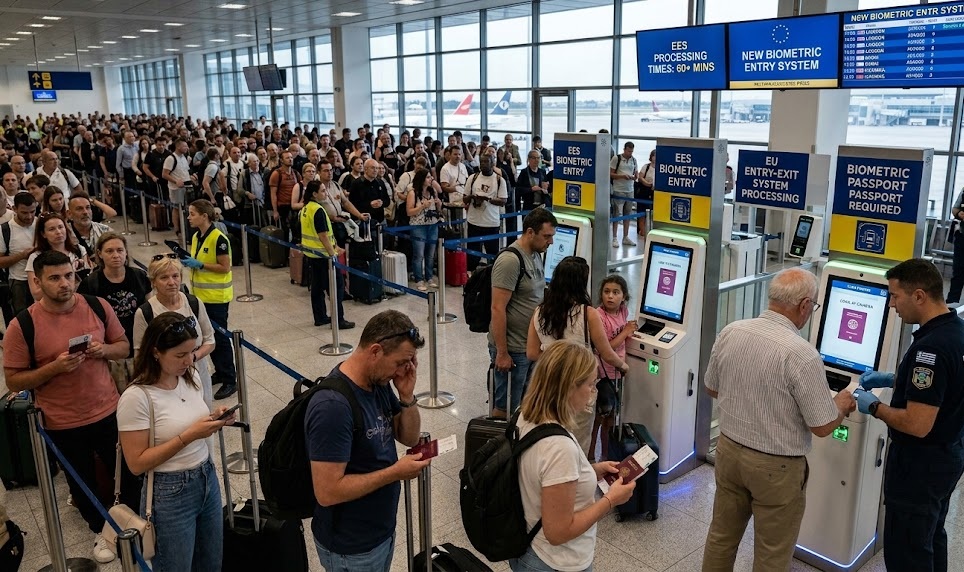
Greece has become the latest country caught in Europe’s worst border crisis as the EU’s new biometric Entry-Exit System (EES) triggers massive traveler backlogs, operational breakdowns, and tourism disruption across the continent. The system, which went into effect on April 10, 2026, now affects Greece, Albania, United Kingdom, North Macedonia, Serbia, Kosovo, Montenegro, and dozens more countries, leaving thousands of travelers stranded at borders.
What’s Happening: The EU’s New Biometric System
The EU Entry-Exit System requires all non-EU travelers to submit biometric data (photos and fingerprints) at border checkpoints. Passport stamps are being phased out, and travelers are now scanned electronically before entering or exiting the EU. While the system was designed to improve security, it has instead created severe congestion at borders across Europe.
Greece, a major gateway for tourists traveling to islands like Santorini, Crete, and Mykonos, is experiencing overwhelming delays at airports including Athens International Airport and Thessaloniki Airport. Travelers report waiting 2-4 hours just to clear border controls, with some families facing 6-hour delays during peak summer travel.
Albania, North Macedonia, Serbia, Kosovo, and Montenegro—countries that border the EU—are also facing similar operational breakdowns. The United Kingdom, despite not being part of the EU, is experiencing cross-border disruptions as travelers attempt to reach EU destinations through UK airports.
The Crisis: Tourism Disruption and Operational Breakdown
The EES has caused widespread tourism disruption across Europe:
Athens, Greece: Airports experiencing 2-4 hour delays, with some travelers facing 6-hour waits
Albania: Tirana International Airport reporting massive backlogs at biometric checkpoints
North Macedonia: Skopje Airport experiencing 3-hour border delays
Serbia: Belgrade Airport facing operational breakdowns at entry-exit points
Kosovo: Pristina International Airport reporting 2-3 hour delays
Montenegro: Podgorica Airport experiencing severe congestion
United Kingdom: London Heathrow, Gatwick, and Manchester airports facing cross-border disruptions
The system’s technical failures have left border agents unable to process travelers efficiently. Many checkpoints are overloaded with queues stretching across terminals. Some airports have reported 1,273 delayed flights and 143 cancellations due to EES-related congestion.
Why This Is a Problem
The EES was designed to replace passport stamps with biometric scanning, but it has created unprecedented operational challenges:
- System congestion: Air traffic is at 100.2% of pre-pandemic levels, and the EES adds further delays
- Technical failures: Border systems are crashing, leaving agents unable to process travelers
- Backlog accumulation: Queues are building up faster than agents can clear them
- Peak season pressure: Summer travel is hitting Europe at the worst possible time
- Lack of preparation: Many airports were not adequately equipped for biometric processing
The crisis has hit tourism-heavy destinations hardest. Greece, which relies on tourism for 20% of its GDP, is seeing visitors cancel trips due to delays. Similarly, Albania, North Macedonia, and Montenegro—countries that depend on cruise tourism and island travel—are experiencing significant drops in visitor numbers.
Key Points:
- Greece joins Albania, UK, North Macedonia, Serbia, Kosovo, Montenegro as EU biometric Entry-Exit System triggers massive border backlogs [EES crisis]
- Travelers waiting 2-6 hours at border checkpoints across Europe, with some families facing 6-hour delays during peak summer travel [travel delays]
- 1,273 delayed flights and 143 cancellations reported due to EES-related congestion at major European airports [flight disruptions]
- Technical failures causing border systems to crash, leaving agents unable to process travelers efficiently [operational breakdown]
- Greece’s tourism sector hit hardest as delays cause visitors to cancel trips, impacting 20% of Greece’s GDP [tourism disruption]
- Summer travel pressure at worst possible time, with air traffic at 100.2% of pre-pandemic levels adding to EES delays [peak season crisis]
Bottom Line: The EU’s biometric Entry-Exit System has triggered Europe’s worst border crisis, with Greece joining Albania, UK, North Macedonia, Serbia, Kosovo, and Montenegro as travelers face 2-6 hour delays and operational breakdowns. The system’s technical failures caused 1,273 delayed flights and 143 cancellations, severely disrupting tourism. With summer travel hitting at peak time and air traffic at 100.2% of pre-pandemic levels, travelers should expect long delays, arrive early, and prepare for ongoing disruptions across Europe



More Stories
GIC Acquires 16 Marriott-Operated Hotels in Japan for About $800 Million Amid Tourism Boom
Spire Hospitality Launches AI-Driven Strategic Asset Performance Division for Hotel Owners
Hilton, Accor, Wyndham CEOs Split on AI Jobs as Voice Agents Lift Hotel Bookings