









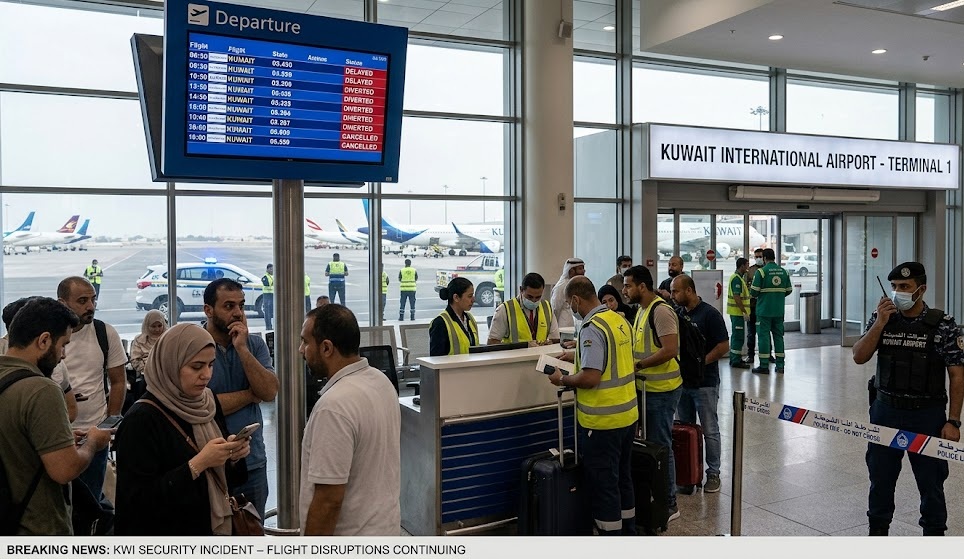
An Iranian drone strike hit Kuwait International Airport on June 3, 2026, killing one person and injuring 63 others, including passengers and airport workers, while causing significant damage to Terminal 1. Kuwait declared the attack “heinous Iranian aggression,” and immediately suspended all commercial flights with airspace remaining closed “until further notice,” triggering a full-scale emergency response and massive flight diversions across the Gulf.
The Attack: What Happened
Kuwait released CCTV footage showing an Iranian drone striking the passenger terminal, causing major material damage and panic among travelers and airport staff. The Defense Ministry reported that “multiple aggressive drones” targeted Terminal 1, with one person killed and dozens wounded from fractures, head wounds, brain hemorrhages, amputations, and smoke inhalation. Kuwait’s Ministry of Health activated emergency response plans, mobilizing medical teams and performing seven major emergency surgeries on the injured.
Iran’s Islamic Revolutionary Guard Corps (IRGC) claimed the damage resulted from an errant U.S. Patriot missile, but the U.S. Central Command (CENTCOM) called this “false,” labeling the attack “deliberate, calculated, and unjustified”. Iran said the strike was retaliation for earlier U.S. attacks on an Iranian oil tanker and Qeshm Island in the Strait of Hormuz.
Flight Suspensions and Diversions
Kuwait’s General Directorate of Civil Aviation suspended all commercial flights “until further notice” as the airport’s airspace remained closed following the strike. Flights were diverted to alternative airports across the Gulf, including in Bahrain, Saudi Arabia, and the UAE, while security assessments continued. The airport had only reopened on Monday after an earlier closure due to the renewed conflict, making the strike even more disruptive.
Later that day, civil aviation officials announced a partial reopening, with Kuwait Airways resuming flights from Terminal 4 (T4)—unaffected by the attack—while no other flights would operate.
Regional Tensions Escalate
The strike was part of a wave of Iranian missile and drone attacks targeting U.S. military facilities and allies in the Gulf, with Iran also attacking Bahrain in the same barrage. Kuwait and Bahrain condemned the Iranian assault, while U.S. CENTCOM said all missiles were intercepted or failed to hit their targets, preventing direct strikes on U.S. facilities. This marks one of the most serious exchanges since the truce began, further testing the fragile ceasefire between Iran and the U.S.
Key Points
- An Iranian drone hit Terminal 1 at Kuwait International Airport on June 3, 2026, killing one person and injuring 63 others, causing significant terminal damage.
- Kuwait suspended all commercial flights and closed airspace until further notice, with flights diverted to alternative Gulf airports.
- Iran claimed the attack was retaliation for U.S. strikes, while the U.S. called it a “deliberate and unjustified attack” on civilian infrastructure.
- Kuwait Airways resumed flights from Terminal 4 after partial reopening, but no other flights operate as the airport remains partially closed.
Bottom Line: The Iranian drone strike on Kuwait International Airport has turned a major civilian aviation hub into a flashpoint in the escalating Iran-U.S. conflict, killing one person, injuring dozens, grounding flights, and triggering a regional emergency that is reshaping air travel across the Persian Gulf.




More Stories
Flights Cancelled Across Europe As Rome, Catania And More Face Disruption
FAA Fines Unruly Airline Passengers $1.5 Million in 2026
Asia Travel Disrupted by 3,657 Delays